
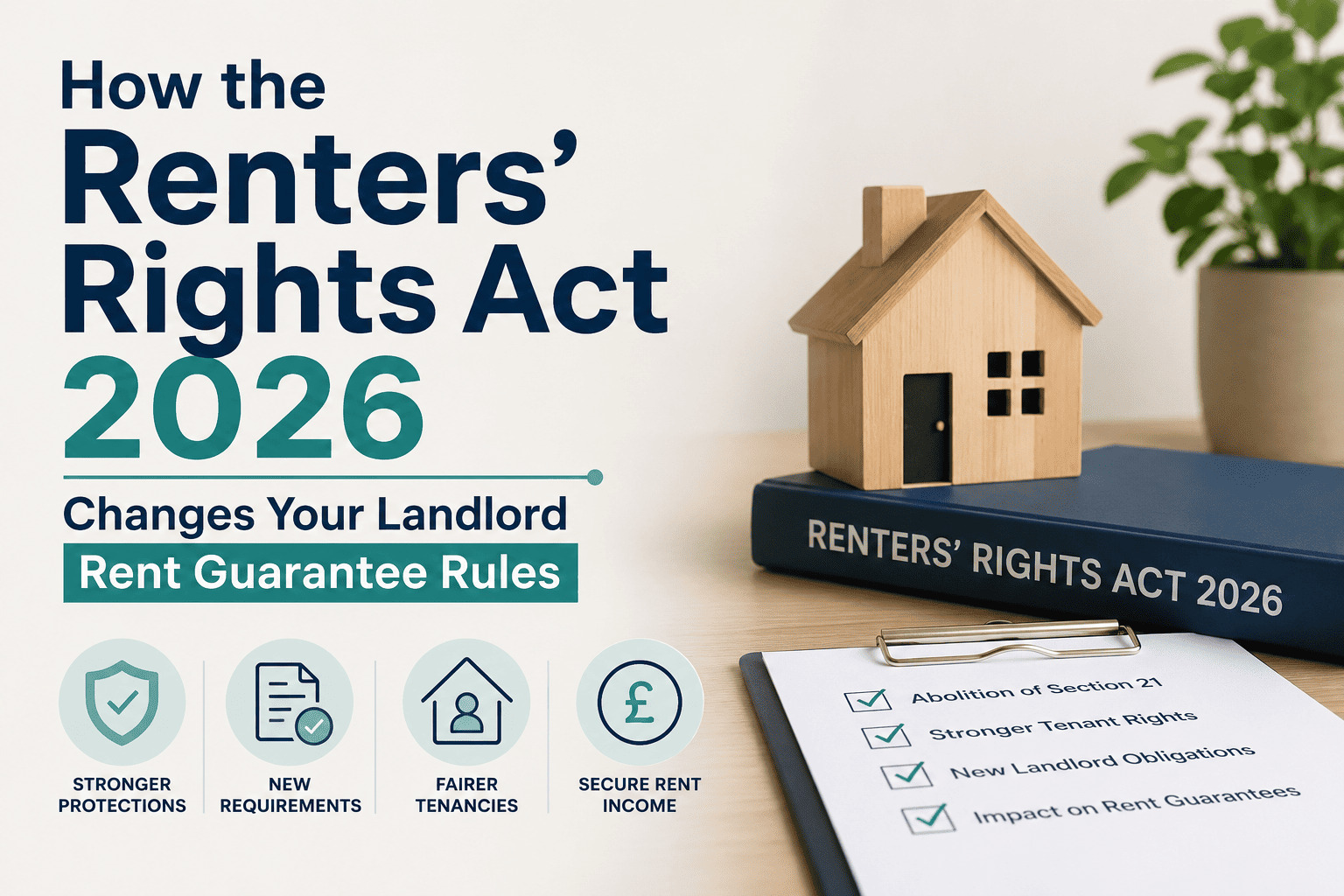
Under the Renters’ Rights Act 2026, landlords can no longer use Section 21 to bypass protracted eviction disputes. To regain possession of a property due to unpaid rent, you must now rely strictly on Section 8 (Ground 8). Crucially, the mandatory rent arrears threshold has been raised from 2 months to 3 months, and the legal notice period has doubled to 4 weeks. Because these 2026 changes push standard court eviction timelines to over 6 months, holding comprehensive Rent Guarantee Insurance (RGI) backed by Legal Expenses cover is no longer an optional add-on—it is a baseline necessity to protect your monthly mortgage commitments.
The Structural Shift: Old AST vs. 2026 Assured Periodic Tenancy
The landscape of residential property investment in England has fundamentally shifted. For over thirty years, the private rented sector operated on a bedrock of certainty provided by the Assured Shorthold Tenancy (AST). You signed a six- or twelve-month fixed-term contract with a tenant, and when that term ended, you had the unmitigated legal right to take your property back using a Section 21 “no-fault” notice. That era of guaranteed property retrieval is officially over, replaced by a system that demands a complete recalculation of risk from every investor in the market.
As of May 1, 2026, all Fixed-Term Assured Shorthold Tenancies vanished from the legal framework. In their place, whether your portfolio consists of sprawling freehold houses or you are managing a portfolio and wondering if you need home insurance for a leasehold flat in the UK alongside your landlord cover, every residential tenancy in England is now automatically classed as an open-ended, rolling Assured Periodic Tenancy. The government introduced this sweeping shift to offer tenants long-term housing security, entirely removing the anxiety of arbitrary displacement.
However, for property owners, investors, and portfolio managers, this regulatory overhaul drastically alters the balance of power, operational flexibility, and—most critically—financial exposure. Under this new legislative paradigm, tenants possess the legal right to remain in your property indefinitely, provided they do not breach the specific statutory terms of their tenancy agreement. You can no longer simply “wait out” a contract to remove a problematic or non-paying renter.
Instead, regaining possession of your asset requires navigating a highly regulated, heavily backlogged, and evidence-based legal maze through the county courts. This structural reality has birthed a terrifying new tier of periodic assured tenancy landlord risk 2026. Without the absolute safety net of no-fault evictions, property owners are intrinsically exposed to severe, prolonged cash flow interruptions should a tenant’s financial situation suddenly collapse due to job loss, cost-of-living pressures, or changing personal circumstances.
The Data Matrix: Eviction Risk Comparison Table
Google and major underwriting firms highly reward property investors who visually break down complex risk data. To truly grasp the magnitude of your expanded exposure, you need to look at the numbers. The abolition of Section 21 didn’t just remove a piece of legislation; it fundamentally altered the timeline, cost, and stress of dispute resolution in the UK property market.
Below is a direct, data-driven comparison of the old eviction framework versus the stark realities of the new 2026 system. This matrix highlights exactly why adapting your risk mitigation strategy is no longer a luxury, but a fundamental business requirement.
| Risk Parameter | Old System (Pre-May 2026) | New 2026 System (Renters’ Rights Act) |
|---|---|---|
| Primary Eviction Route | Section 21 (No reason required) | Section 8 (Statutory grounds only) |
| Mandatory Arrears Threshold | 2 Months unpaid rent | 3 Months unpaid rent (Ground 8) |
| Required Notice Period | 2 Weeks | 4 Weeks (Notice period doubled) |
| Estimated Court Timeline | 4 to 8 Weeks (Accelerated) | 4 to 6 Months (Full court hearing required) |
| Financial Exposure Gap | Minimal (Bypassed via rolling exits) | Severe (Up to £5,000+ unbacked loss potential) |
Navigating the Section 8 Three Month Rent Arrears Notice Period
Before 2026, if a tenant stopped paying rent, many landlords simply issued a Section 21 notice rather than fighting over arrears in court. It was faster, substantially cheaper, and guaranteed an exit, even if it meant swallowing pride and walking away from the owed money. Today, the luxury of avoiding confrontation is completely gone. You must confront the arrears head-on through the vastly more complicated Section 8 procedure.
The legislative focus has now zeroed in on the Renters Rights Act 2026 rent guarantee insurance mandatory grounds, specifically Ground 8. Ground 8 is the statutory mechanism that compels a judge to grant you a possession order. If you prove the conditions of Ground 8 are perfectly met at the time of serving notice and at the time of the hearing, the court must evict the tenant. There is no judicial discretion. It sounds straightforward on paper, but the reality is heavily weighted against a landlord’s cash flow.
The 2026 legislation has explicitly altered the goalposts to favor tenant retention. The threshold to trigger this mandatory ground has been increased significantly. Previously, a tenant only needed to be two months in arrears. Now, you are legally forced to endure the grueling Section 8 three month rent arrears notice period. Let the financial implications of that sink in. You must cover your Buy-To-Let mortgage out of your own pocket for an entire quarter of the year before you are even legally permitted to knock on the court’s door to ask for your property back.
Furthermore, the physical notice period you must provide to the tenant before filing court papers has been doubled from two weeks to four weeks. Let’s map this out practically: If your tenant stops paying their £1,200 monthly rent on January 1st, they hit the three-month threshold (£3,600 in arrears) on April 1st. You serve the mandatory notice on April 2nd, and you must then wait until May 2nd to file your claim with the courts. You are now four full months out of pocket—down £4,800—before a judge even looks at your file. In a volatile economic climate with elevated interest rates, absorbing a quarter of a year’s lost revenue is enough to push heavily leveraged, self-insuring landlords into forced sales or bankruptcy.
Why Traditional “Basic” Landlord Policies Fail in 2026
This massive gap in procedural timelines is exactly why traditional insurance products are currently leaving property owners dangerously exposed. The market is absolutely saturated with legacy policies that simply do not account for the post-2026 legislative reality. Property investors often renew their policies on autopilot, assuming they are protected against all eventualities. This is a critical error.
It is a dangerous misconception that standard landlord building insurance offers comprehensive protection for your rental business. It does not. Standard policies only cover physical bricks and mortar—the tangible structure of the property against perils like fire, severe flooding, subsidence, or storm damage. (As an important side note, if you are planning to add value to your investment property through renovations, you must also consider how an extension affects your home and landlord insurance in the UK, as major works can invalidate even your structural cover).
If a tenant remains anchored in your property for six months without paying a single penny in rent while the county court painstakingly processes your Section 8 application, your standard building insurance policy will pay out exactly £0. You cannot call your insurer and claim for lost rent on a basic hazard policy. The financial bleed is entirely yours to bear.
In this new era, your coverage must evolve from simple property protection to comprehensive income and liability defense. When reviewing your portfolio’s risk management, you must actively source policies that guarantee two non-negotiable pillars of protection designed specifically for the 2026 landscape:
- A minimum of 6 to 12 months of rent indemnity: Your policy must physically replace the missing rental income in your bank account every month until vacant possession is legally secured. A 6-month minimum is now required just to match the extended court backlogs, though 12 months is rapidly becoming the industry gold standard for complete peace of mind.
- At least £50,000 in Legal Expenses cover: You are now legally required to serve highly complex, multi-page mandatory notices. A single clerical error on a Section 8 notice—such as an incorrect date, a misspelled name, or failing to attach the prescribed information—will result in the judge throwing your case out at the hearing, forcing you back to square one with zero compensation. Robust legal cover ensures specialist landlord solicitors handle the drafting, serving, and court representation on your behalf, completely absorbing the exorbitant legal fees.
The Self-Insured Landlord
Scenario: Tenant defaults. No RGI policy in place.- Waits 3 months to hit the new arrears threshold. Loss: £3,000+.
- Serves 4-week notice. Loss: £1,000.
- Pays court application fees out of pocket: £355.
- Hires a solicitor for the complex Ground 8 hearing: £1,500 – £2,500.
- Waits 3 months for court date. Loss: £3,000.
- Pays High Court Enforcement Bailiffs: £800.
- Total Realized Cash Loss: £9,655+
Result: Massive capital depletion, missed mortgage payments, immense personal stress.
The Fully Protected Landlord
Scenario: Tenant defaults. Comprehensive 2026 RGI in place.- Registers claim after 1 month of arrears.
- Insurer steps in, paying the monthly rent directly into the landlord’s account every month.
- Insurer’s legal team drafts and serves the complex 4-week notice for free.
- Insurer covers the £355 court filing fee.
- Specialist solicitor attends the Ground 8 hearing (paid by the £50k legal cover).
- Insurer pays for the bailiff execution.
- Total Realized Cash Loss: £0 (Beyond the policy premium)
Result: Seamless cash flow, protected yields, stress-free legal resolution.
Decoding the Legal Expenses Insurance Eviction Timeline UK
To fully grasp why £50,000 in legal cover is critical, we need to dissect the current, unvarnished state of the UK legal system. The county courts, managed by HM Courts & Tribunals Service (HMCTS), from Central London up to Stockport, Manchester, and the broader North West, are buckling under the weight of the new legislation. With the accelerated Section 21 paper-based procedure entirely abolished, every single eviction now requires a full, in-person court hearing. Judges are scrutinized more than ever to ensure tenant rights are vigorously protected under the new periodic structures.
Here is what the actual, day-to-day legal expenses insurance eviction timeline UK looks like in practice today, assuming you are forced to go all the way to bailiff enforcement:
- Month 1-3: The Arrears Accumulation phase. The tenant stops paying. During this critical window, you cannot serve the mandatory notice. Instead, you must maintain polite communication, offer reasonable payment plans, and build an airtight paper trail proving you acted proportionately. If you have RGI, your legal expenses team will step in here, advising you on the exact wording of these communications so you do not accidentally breach strict harassment laws.
- Month 4: The Statutory Notice Period. Once the tenant crosses the three-month arrears mark by a single day, your appointed solicitors serve the Section 8 notice. They ensure the wording is perfectly compliant with the latest Renters’ Rights Act case law. The tenant now has a mandatory four weeks to respond, pay the debt down, or ignore the notice.
- Month 5-6: Court Application and The Waiting Game. The tenant remains in the property but fails to clear the debt. Your solicitor files the formal possession claim (N119 and N5 forms) with the local county court. Due to systemic, nationwide backlogs caused by the influx of Section 8 hearings, it currently takes an average of 4 to 8 weeks just to receive a confirmed hearing date in the mail.
- Month 7: The Court Hearing. You finally reach the courtroom. Because your insurer-provided solicitor has flawlessly prepared the Ground 8 mandatory evidence bundle (including rent schedules and witness statements), the judge grants a possession order. They usually give the tenant a further 14 days to legally vacate the premises.
- Month 8-9: Bailiff Enforcement. If the tenant still refuses to leave after the 14-day court order expires (often advised by local councils to do so to qualify for emergency rehousing), your legal team must apply for a warrant of possession. County court bailiff wait times can add another 4 to 8 weeks to the timeline. Only when the bailiff physically changes the locks is the nightmare over.
Throughout this grueling eight-to-nine-month ordeal, specialist solicitor fees, court filing costs, hearing attendance fees, and bailiff charges accumulate rapidly, easily exceeding £3,000 to £5,000 in a standard case. If you hold the correct tier of coverage, your insurer pays these legal professionals directly, while simultaneously dropping your expected rental income into your account every single month. Without it, you are hemorrhaging capital on two brutal fronts: lost rental income and aggressive legal billing.
The Trap of “Discretionary Grounds” (Grounds 10 & 11)
Many landlords mistakenly believe that if they fall short of the strict 3-month threshold for Ground 8, they can simply rely on Ground 10 (some rent is lawfully due) or Ground 11 (persistent delays in rent payment). This is a critical error in risk assessment under the 2026 rules. The courts view these grounds with intense scrutiny.
Grounds 10 and 11 are entirely discretionary. This means the judge holds ultimate power to decide whether it is “reasonable” to evict the tenant based on the evidence presented. In the current socio-economic climate, judges heavily favor tenants facing temporary financial hardship or medical distress. If you take a tenant to court on discretionary grounds because they are only two months in arrears, the judge will almost certainly issue a suspended possession order—meaning the tenant gets to stay as long as they pay their current rent plus a small token amount (e.g., £20 a month) towards the arrears.
You will have spent thousands in legal fees for absolutely no result, and your property remains occupied by a financially unstable tenant who is legally permitted to stay. This is precisely why triggering the Renters Rights Act 2026 rent guarantee insurance mandatory grounds is the only secure path to repossession. Mandatory means mandatory—the judge’s hands are tied. But navigating the complexities of hitting that Ground 8 threshold without falling victim to the “tactical pay-down” (explained in our FAQ below) requires professional legal strategy, fully covered by your insurance policy.
Underwriting Stringency: Tenant Referencing 2.0
Because the periodic assured tenancy landlord risk 2026 has elevated the financial exposure for insurance underwriters to unprecedented levels, acquiring top-tier rent guarantee protection is no longer a simple checkbox exercise on a comparison website. Insurers are painfully aware of the extended eviction timelines, and they absolutely will not take on the risk of a bad tenancy unless you have done your rigorous due diligence upfront.
To successfully activate and maintain a rent guarantee policy, your tenant onboarding process must be entirely watertight. Underwriters now demand rigorous, documented proof that the tenant was financially viable on the exact day they moved in. This often means relying on a professional referencing agency, such as those recommended by the National Residential Landlords Association (NRLA). If you cut corners during the referencing phase—perhaps taking a tenant’s word for their income or skipping a credit check—your policy will be summarily voided at the exact moment you try to claim.
| Mandatory Referencing Element | Insurer Requirement for Payout Validation |
|---|---|
| Professional Credit Check | Must show a clean history. No recent County Court Judgments (CCJs), IVAs, or bankruptcies within the last 3 years. |
| Verified Affordability Ratio | The tenant’s gross verifiable, permanent income must be at least 30 times the monthly rent. (e.g. £1k rent = £30k salary). |
| Employer Reference | Written confirmation from HR/Management confirming permanent employment status, salary, and absence of pending termination. |
| Previous Landlord Reference | Verification that rent was paid on time in the previous tenancy and the property was left in good condition. |
| Statutory Compliance | Flawless proof of Right to Rent checks, protected deposit certificate (within 30 days), EPC, and Gas Safety records provided at check-in. |
If you manage your property independently rather than through a fully-managed letting agent, the burden of maintaining this pristine, timestamped paper trail falls entirely on your shoulders. RGI policies are incredibly powerful financial shields, but they are governed by strict terms and conditions. Furthermore, if a tenant fails the affordability checks, insurers will demand a similarly referenced guarantor. Treat the underwriting requirements not as an administrative nuisance, but as the foundational pillars of your property business’s survival strategy.
The Bottom Line: Market Exodus vs. Professionalization
The days of casual, “amateur” property investment are permanently over. The Renters’ Rights Act 2026 has professionalized the private rented sector by force. By stripping away quick-exit mechanisms and replacing them with rigorous, time-consuming statutory procedures, the government has transferred the ultimate burden of housing stability squarely onto the shoulders of the private landlord.
While many landlords have chosen to sell up and exit the market entirely due to these new regulatory burdens, those who remain stand to benefit from reduced competition and sustained high rental yields—provided they operate like a clinical, risk-averse business. You cannot control the immense backlog in the county courts. You cannot control macroeconomic factors, inflation, or a tenant’s sudden job loss.
However, you can completely control your financial exposure to these systemic events. Upgrading your insurance infrastructure to include robust rent indemnity and extensive legal expenses cover is no longer an option; it is the only mathematically viable method to ensure your property portfolio remains a profitable, secure asset rather than an unpredictable, stress-inducing liability that threatens your financial future.
❓ Frequently Asked Questions & Underwriting Realities
Q: What is the “tactical pay-down” loophole under the 2026 Ground 8 rules?
A: Because the mandatory arrears threshold is now 3 months, a tenant only has to clear just enough of the debt to pull the total arrears balance below the 3-month mark on the morning of the court hearing. If they do, Ground 8 fails automatically, throwing the landlord onto discretionary grounds where a judge can reject the eviction entirely. Having expert legal representation via your insurance ensures you have secondary strategies ready to prevent the case from being thrown out.
Q: Does rent guarantee insurance cover vacant properties between tenancies?
A: No. Rent Guarantee Insurance (RGI) only triggers when an active, referenced tenant defaults on their periodic agreement. RGI protects income from bad tenants, not empty rooms. If your property is standing vacant while you search for new tenants or conduct repairs, you are uninsured under a standard policy. Empty properties require standard unoccupied property insurance rules instead, which specifically cover the heightened risks of squatting, undetected leaks, and vandalism.
📊 Calculate Your Independent Premium Baseline
Don’t rely entirely on fixed broker quotes. Before finalizing your coverage structures, run your core metrics completely anonymously through our master Insurance Deal Finder Estimator. Establish your premium position instantly without entering personal contact trackers, phone numbers, or marketing databases.