
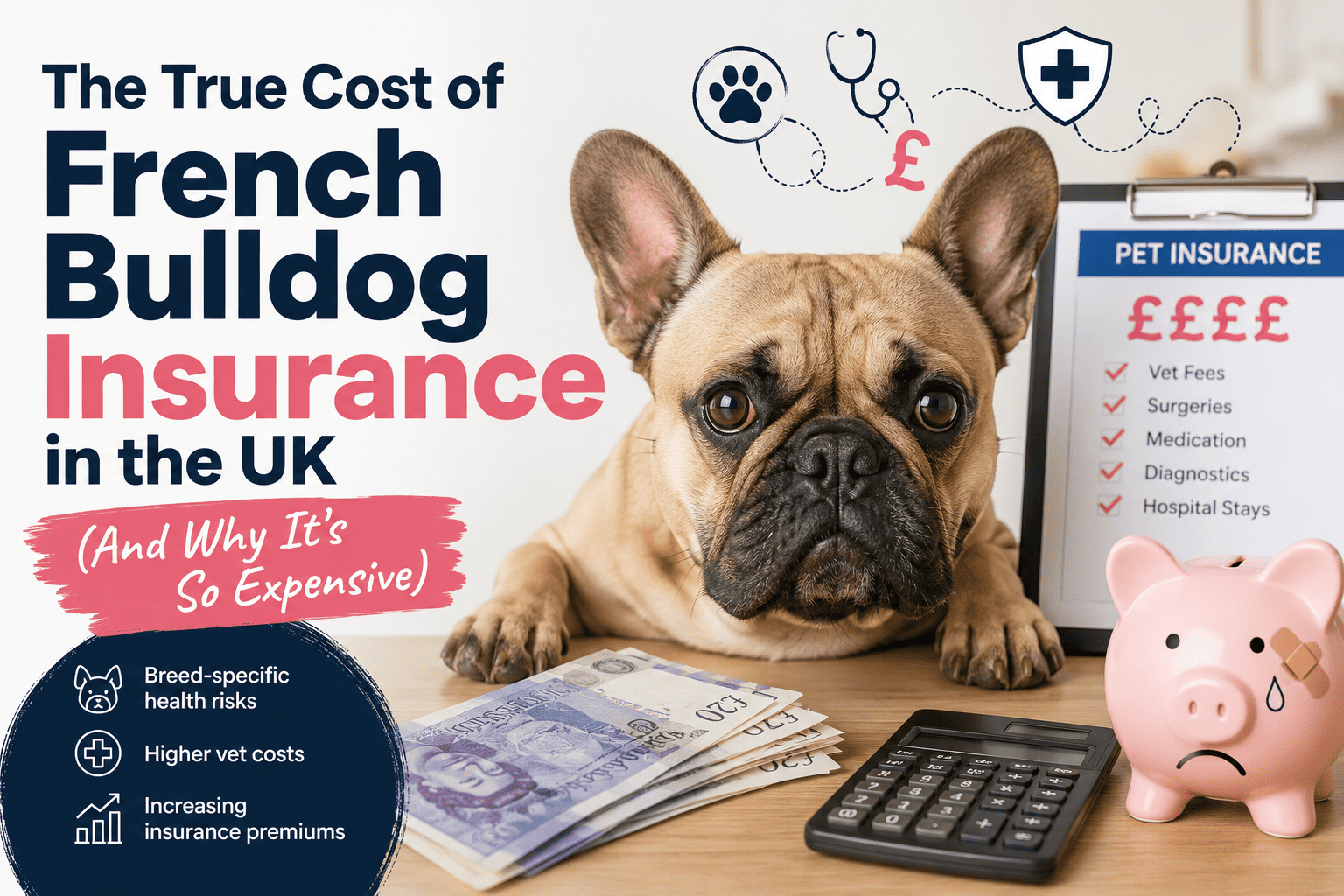
It is a classic scenario played out in thousands of British living rooms every single week. You bring home a gorgeous, bat-eared French Bulldog puppy. They are full of personality, incredibly affectionate, and instantly become a central part of the family. You jump online to grab a quick, routine pet insurance policy, expecting to pay the standard fifteen or twenty pounds a month you paid for your old family crossbreed.
Then the screen loads, and you nearly fall off your chair. The cheapest premium on the page is fifty pounds a month, and the comprehensive policies are pushing close to three figures.
If you are currently experiencing massive sticker shock over the French Bulldog insurance cost UK providers are throwing at you, it is completely understandable to feel frustrated. You might think the insurers are simply taking advantage of the breed’s massive popularity. However, the reality inside the insurance industry is entirely different.
Underwriters are not punishing Frenchie owners out of greed. They are operating on cold, hard actuarial mathematics. Because of how these dogs are physically bred, they represent the single highest medical risk profile in the domestic pet market.
In this long-form 2026 guide, we are going to strip away the marketing fluff. We will break down exactly why is French Bulldog insurance so expensive, look at the actual market averages by age, examine the specific hereditary conditions that drive these prices up, and show you exactly how to structure your policy to get the cost back down without leaving yourself exposed to ruinous vet bills.
The Hard Numbers: Average Cost of French Bulldog Insurance
Before looking at how to reduce your bill, you need to know what a fair market price looks like. If you run a quote on a standard comparison engine, the premium you are offered is heavily dictated by two factors: your postcode and your dog’s age.
Pet insurance scales aggressively as a dog gets older, but with French Bulldogs, that scaling curve is exceptionally steep. Here is what the typical UK market baseline looks like for a comprehensive, high-tier Lifetime policy with a £4,000+ annual limit:
| Dog’s Age Range | Typical Monthly Premium | The Underwriter’s Risk Assessment |
|---|---|---|
| Puppy (Under 1 Year) | £35 – £55 | Clean slate. The algorithm assumes the dog is healthy but loads the premium based on breed statistics. |
| Young Adult (1 – 4 Years) | £55 – £85 | The danger zone for hereditary respiratory and spinal defects to physically manifest. |
| Mature Adult (5 – 8 Years) | £90 – £150+ | High probability of chronic conditions (allergies, arthritis) requiring lifetime monthly medication. |
| Senior (9+ Years) | £160 – £250+ | Extreme risk bracket. Mainstream providers often introduce a mandatory 20% co-payment on top of the excess. |
If you live inside the M25 or in a major metropolitan hub like Manchester or Birmingham, you can safely add an extra 20% to 30% onto those numbers. Referral vets in these areas charge significantly higher corporate fees for surgeries, and local insurance premiums are adjusted to match those regional costs.
Why Is French Bulldog Insurance So Expensive? The “Big Three” Claims
To understand why the baseline is so high, you have to look at what happens behind the scenes at a veterinary referral hospital. Insurers price their policies based on the average payout per claim. For a Frenchie, the average payout is staggering because their health problems are rarely simple fixes.
There are three specific medical conditions that keep UK pet underwriters awake at night. If your dog develops just one of these, the lifetime cost to the insurer can easily cross five figures.
1. BOAS (Brachycephalic Obstructive Airway Syndrome)
Because Frenchies are bred to have short, flat faces, their internal respiratory tract is fundamentally compressed. They have narrowed nostrils (stenotic nares) and an elongated soft palate that partially blocks their windpipe. This is what causes that trademark “cute” snorting and snoring—but to a vet, that sound is a sign of a dog struggling for oxygen.
When the breathing difficulty becomes severe, the dog requires complex airway surgery to widen the nostrils and trim back the excess tissue in the throat. In the UK, a standard Frenchie BOAS surgery insurance claim regularly totals between £2,000 and £4,000. If the dog requires an overnight stay in an oxygen kennel, the bill climbs rapidly.
2. IVDD (Intervertebral Disc Disease)
French Bulldogs carry a specific genetic mutation that causes dwarfism, giving them their stocky shape and short legs. Unfortunately, this mutation also causes the cartilage in their spines to age prematurely. A simple jump off a sofa or a twist while fetching a ball can cause a disc in their back to rupture or herniate, compressing their spinal cord.
IVDD is an absolute emergency that can cause permanent paralysis within hours. Diagnosing it requires an emergency MRI scan (costing roughly £1,500 to £2,500). If spinal decompression surgery is needed, the final bill routinely hits £5,000 to £7,000. Because this is an inherent breed trait, underwriters price every policy assuming an IVDD event could happen at any moment.
3. Chronic Atopic Dermatitis (Skin Allergies)
While surgery is a massive one-off hit, chronic conditions are often what drain insurance pots over the long term. Frenchies are notorious for suffering from severe environmental and food allergies. They develop raw, infected skin folds, constant ear infections, and sore paws.
Managing a severely allergic Frenchie requires a lifetime of specialized care: monthly immunotherapy injections (like Cytopoint or Apoquel), hypoallergenic prescription diets, and regular medicated baths. This can easily run up a bill of £100 to £150 every single month. Over an eight-year lifespan, that is over £12,000 in continuous claims for a single condition.
The Absolute Necessity of Lifetime Pet Insurance for Flat-Faced Dogs
When faced with a high premium, it is incredibly tempting to scroll down to the bottom of the comparison site and select a cheap “Time-Limited” or “Maximum Benefit” policy just to save twenty quid a month.
With a French Bulldog, doing this is an absolute financial trap.
A Time-Limited policy only covers a condition for exactly 12 months from the date of the first symptom. If your Frenchie develops skin allergies at age two, the policy will pay out for one year. When you renew at age three, that skin allergy is permanently excluded as a “pre-existing condition.” You are then entirely on your own to pay for that medication for the next decade.
A Maximum Benefit policy gives you a fixed financial pot per condition—for example, £3,000. If your dog suffers a complex IVDD spinal injury, that £3,000 pot will be completely wiped out by the initial MRI and diagnosis stage before the surgeon even picks up a scalpel.
If you own a flat-faced breed, you must buy lifetime pet insurance for flat-faced dogs. A Lifetime policy resets your financial pot every single year on renewal. If you have a £7,000 annual limit, and your dog uses £5,000 for chronic allergy treatments this year, that pot resets back to a full £7,000 next year, ensuring they are protected for life.
4 Insider Tactics to Lower Your Frenchie’s Premium
You cannot change your dog’s genetics, but you can change how you manage the financial risk to lower your monthly outgoings. Use these four industry strategies to manipulate the algorithms in your favour.
1. Opt for a Co-Payment (Percentage Contribution)
The single most effective way to slash a French Bulldog premium is to shift some of the risk off the insurer’s books. Standard policies require you to pay a fixed excess (usually around £99 per year or per condition).
If you choose to add a voluntary 20% co-payment, you agree that in the event of a claim, you will pay the first £99 plus 20% of the remaining bill. Because this drastically reduces the insurer’s potential payout, their algorithms will instantly drop your monthly premium by up to 30% to 40%. It means you need to keep an emergency fund in a savings account, but your monthly fixed overhead drops significantly.
2. Insure the Puppy Before They Ever See a Vet
The absolute biggest mistake new owners make is taking their new puppy to the vet for a routine check-up, mentioning offhand that the puppy “snorts a bit when excited,” and then going home to buy insurance.
The moment a vet writes “slight stertor” or “snorting noted” in the medical history logs, that counts as a clinical sign. If you buy insurance the next day, respiratory conditions will be flagged as pre-existing, and you will never be able to claim for BOAS surgery. Buy the policy the day you pick up the puppy so your medical records are completely blank when the policy’s standard 14-day exclusion window ends.
3. Use a Higher Fixed Excess
If your policy is set to a standard £60 excess, you are telling the insurer you intend to claim for minor issues like minor ear infections or a mild bout of sickness. Processing these micro-claims costs the insurer a fortune in admin fees. Bumping your fixed excess up to £150 or £250 stops you from claiming for small things, but it keeps the policy affordable so it is there to save you from a catastrophic £6,000 spinal surgery bill.
4. Look for “Per-Condition” vs. “Per-Year” Excess Structures
Read the fine print. Some insurers charge the excess every single year for a chronic condition. Others charge the excess once per condition per lifetime. For a Frenchie prone to multiple long-term issues, picking an insurer with a clear, single-excess structure can save you hundreds of pounds as the dog hits maturity.
Frequently Asked Questions (FAQ)
Does KC registration make French Bulldog insurance cheaper?
Surprisingly, no. Kennel Club registration ensures parentage pedigree, but insurance algorithms look strictly at breed-wide health statistics rather than paperwork. A KC-registered Frenchie is just as statistically susceptible to BOAS or spinal issues as a non-registered dog, so the premium rates remain identical.
Why did my Frenchie’s premium double at renewal when I haven’t claimed?
This is the most common complaint among owners. Even if your specific dog has been perfectly healthy, your premium rises because the entire breed pool has claimed heavily over the past 12 months. Insurers adjust their prices sitewide based on the collective cost of veterinary inflation and the volume of French Bulldog claims across the country.
Can I switch insurers if my Frenchie already has diagnosed allergies?
You can physically switch providers at any time, but it is rarely a good idea. Any new insurance company will class the diagnosed allergies as a pre-existing condition and completely exclude them from your new policy. If your dog has a chronic illness, you are essentially “locked in” with your current provider if you want those treatments to remain covered.