
There is a particular kind of frustration that hits at renewal time. You click through a quote, see the words fully comprehensive, and assume that means every possible car disaster has been handled. Then something real happens. A cracked windscreen. A borrowed-car problem. A bag stolen from the boot. A small bump on the way to a second work site. Suddenly you discover that the phrase sounds broader than the policy actually is.
If you have typed “what does fully comprehensive car insurance cover UK” into Google, you are asking exactly the right question. In the comprehensive car insurance UK market, the headline tells you the level of protection, but the small print decides what gets paid.
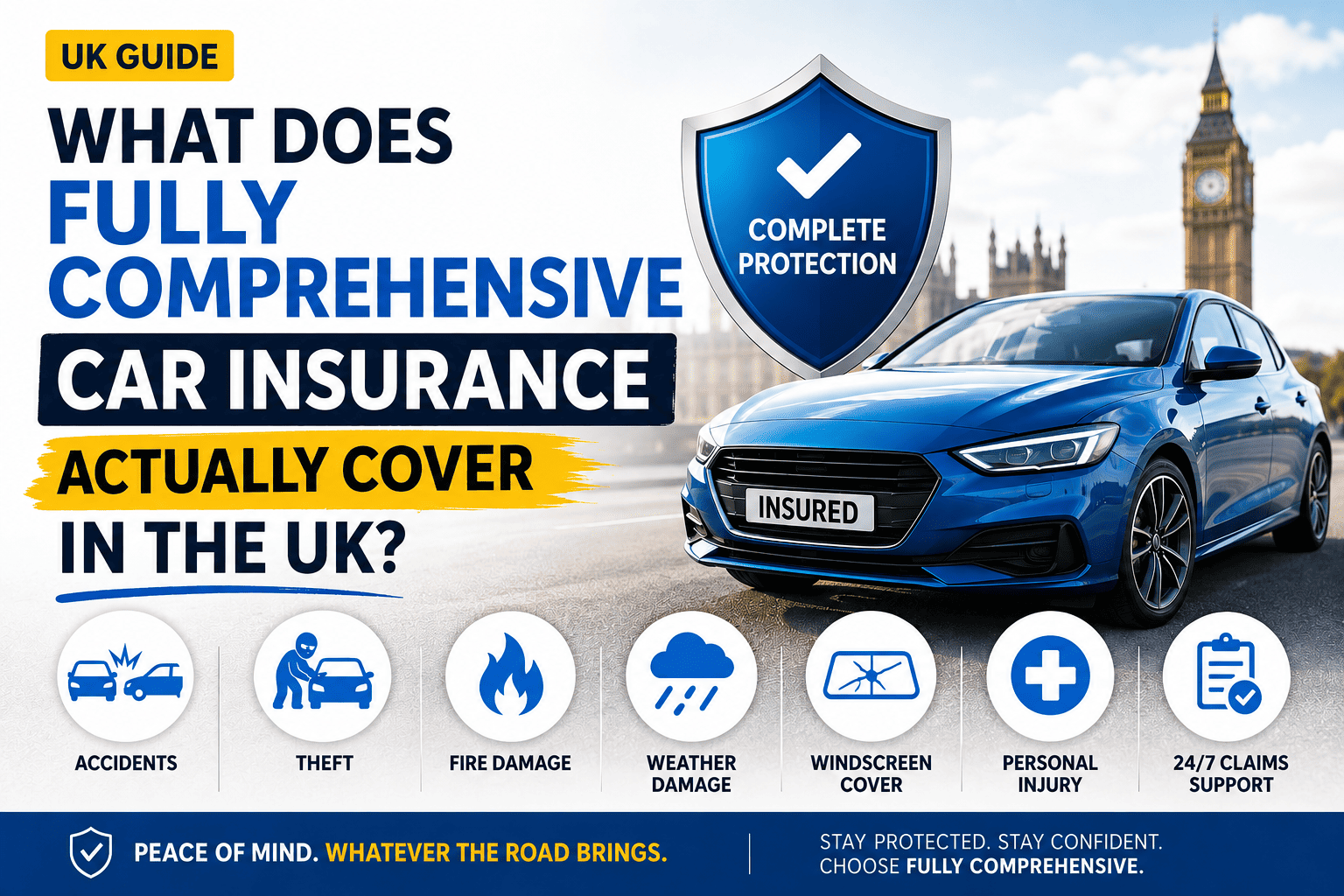
Here’s the short answer. A fully comprehensive policy usually includes coverage for the damages you cause to other individuals, damage to your vehicle itself – yes, including your own fault – fires, thefts, and intentional damage. It may also contain additional features such as windscreen insurance, a courtesy car, and somewhat limited European driving protection.
The Basic Promise of Fully Comprehensive Cover
At the legal minimum, UK drivers only need third-party insurance. That protects other people if you injure them or damage their vehicle or property, but it does nothing for your own car. Fully comprehensive sits at the top of the standard cover ladder because it includes that third-party protection and adds cover for your own vehicle as well.
That is fundamentally the key difference that most motorists really care about. If you end up hitting a bollard by reversing, slide into another car on black ice, or get back to find your parked car vandalized, comprehensive cover is part of the market set up to kick in. That doesn’t mean every loss is automatic, and it definitely doesn’t mean every additional cost is included at no extra charge. It does mean the policy is more extensive, not quite limitless.
What It Covers vs. What It Doesn’t
| Feature | Typical position | What to check |
|---|---|---|
| Damage to other people, their car, or their property | Usually Included | This is the legal core of any UK motor policy. |
| Damage to your own car after an at-fault accident | Usually Included | Check the excess and if market value or repair cost rules apply. |
| Fire, theft, and attempted theft | Usually Included | Read the exclusions around keys, unattended vehicles, & fraud. |
| Malicious damage or vandalism | Usually Included | Look for any specific reporting requirements. |
| Windscreen repair or replacement | Often Included | Check if there is a separate windscreen excess. |
| Courtesy car | Often Included | It may only apply if your car is repairable & fixed at an approved garage. |
| Personal belongings in the car | Sometimes Included | Limits are often low & some valuables may be excluded. |
| Driving other cars | Rarely Standard | If present, it is often third-party only and subject to strict conditions. |
| European driving cover | Varies | Do not assume your UK comprehensive level follows you abroad. |
| Breakdown, legal expenses, key cover, misfuelling | Usually Extra | These are commonly sold as optional add-ons. |
| Wear and tear, mechanical failure, routine maintenance | Usually Excluded | Insurance is not a maintenance contract. |
What It Normally Covers?
Firstly, it covers your liability towards other people. If you cause an accident, your insurer deals with injury claims, repairs to the other driver’s car, and damage to property itself. That aspect isn’t optional. It’s the legal basis of every motor policy in the UK itself.
Second, it usually covers accidental damage to your own car. This is the bit that third-party and third-party, fire and theft do not give you. If your own vehicle needs repairing after a crash, or is written off, a comprehensive policy can pay out up to the policy limits once your excess is applied.
Third, it usually covers theft, attempted theft, fire, and malicious damage. If the car is stolen, set alight, or keyed by someone with too much time on their hands, this is usually where a comprehensive claim starts.
Fourth, many policies also throw in some helpful extras. Windscreen cover is common. Courtesy car cover is common too, although there is often a catch that your vehicle must be repairable and fixed through an approved garage. Some insurers also include limited personal belongings cover, onward travel, or a few weeks of cover for driving in Europe.
The Four Biggest Traps in Comprehensive Car Insurance UK Policies
This is where most people get caught. The same questions show up again and again in UK insurance forums and Reddit threads, and they nearly always come down to four myths.
- Myth one: Fully comprehensive means all extras are standard. It does not. Breakdown cover, motor legal protection, key cover, excess protection, misfuelling cover, and guaranteed hire car upgrades are often optional paid add-ons.
- Myth two: Fully comp means you can drive any other car. Sometimes a policy includes Driving Other Cars cover, but many do not. And even when it is included, it is usually third-party only, not comprehensive on the borrowed car. That is a nasty surprise to discover at the roadside.
- Myth three: Fully comprehensive means the same level of cover abroad. In actuality, lots of UK policies will only provide you with the legally required level of third-party cover in Europe – unless your insurer clearly upgrades it itself. If you’re taking the vehicle to France, Spain, or further afield, you really ought to check the territorial limits yourself before boarding the ferry.
- Myth four: If you have comprehensive cover, your insurer will ignore how you use the car. They will not. Social use, commuting, business use, and delivery work are treated very differently. If you are using the car for work trips to multiple sites, or carrying goods for hire and reward, the wrong class of use can leave you exposed.
There is also one ugly exclusion that catches people off guard. Insurance is for sudden events, not avoidable losses or maintenance issues. Wear and tear, mechanical breakdown, and many theft-by-deception scenarios can fall outside cover. Giving keys to a phony buyer – and the car vanishes – don’t assume your insurance company will quietly take on the loss itself.
What to Check Before You Buy
So what should you really read before buying? Begin with the excess, because that will be your initial out-of-pocket cost if you make a claim. Then check the windscreen excess, the courtesy car rules, whether personal items are covered, whether named drivers get the same level of cover, and whether driving other cars is even included at all.
After that, check the class of use. This sounds boring right up until a claim lands on a desk and the insurer notices you declared social driving only while regularly using the car for work. Finally, check the exclusions section. That is where you will usually find the lines on wear and tear, undeclared modifications, unattended keys, fraud, and non-standard use.
Is Fully Comprehensive Actually Worth It?
Many drivers wonder whether comprehensive coverage makes sense on an older vehicle. The honest truth is that age itself is not the right yardstick. What really matters is this: if your car were stolen today – or seriously damaged in an accident for which you are at fault – would you be comfortable replacing it yourself? If the answer is ‘no’, comprehensive coverage definitely merits careful consideration.
There is another twist here that confuses first-time buyers. Comprehensive cover is often cheaper than third-party or third-party, fire and theft. That sounds backwards, but it happens all the time because insurers price risk based on who tends to buy each product, not just how much protection it offers. So never assume dropping down a level will save money. Quote all three properly before you decide.
vehicle Insurance Quote Engine
Frequently Asked Questions (FAQ)
Does fully comprehensive insurance cover me if an accident is my fault?
Usually yes. That is the main advantage over lower levels of cover. Your insurer can cover damage to your own car as well as third-party costs, subject to the policy terms and your excess.
Can I drive someone else’s car because I am fully comprehensive?
Don’t always assume so. Some policies will include Driving Other Cars cover – others won’t and when they do it’s often third-party only. Always double-check your certificate and policy wording first.
Are my phone, laptop or tools covered if stolen from the car?
Sometimes – but usually up to a limited amount and with plenty of exclusions. Personal belongings cover is one of the most inconsistent bits of comprehensive car insurance UK policies.
Does fully comprehensive include breakdown cover?
Usually no. Breakdown cover is commonly sold as a separate add-on, even on premium comprehensive policies.
Can fully comprehensive be cheaper than third-party insurance?
Yes. It regularly is. Insurers price policies according to risk profiles and claim patterns, so the broadest cover can still come out cheapest for many drivers.