
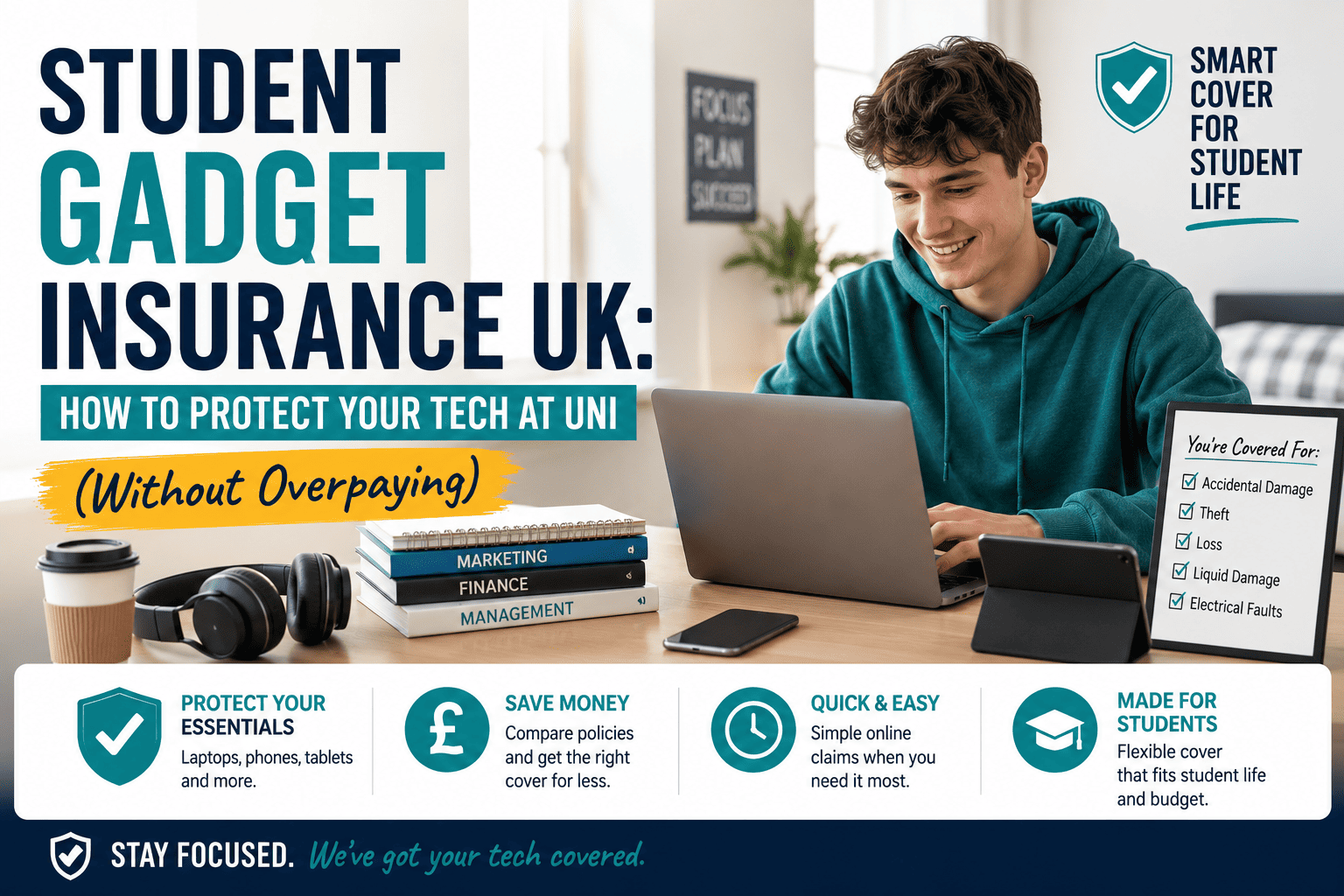
Every September, thousands of cars pull up outside university halls of residence across the UK, packed to the roof with bedding, pots, pans, and massive amounts of technology. If you were to stop a first-year student and empty their backpack as they walk into their first lecture, the sheer financial value of the equipment inside would stagger you.
Between a premium smartphone, a high-spec MacBook or Windows laptop required for coursework, a smartwatch, noise-cancelling headphones for the library, and perhaps a gaming console left back in the room, the average British student is walking around campus with over £2,500 worth of fragile, easily stolen technology.
Despite this massive financial exposure, a shocking number of students arrive at university with absolutely no dedicated protection for their electronics. When they inevitably drop their phone on a night out at the student union, or spill a coffee over their laptop keyboard during an all-night library session, panic sets in.
If you are currently researching the best student gadget insurance UK providers, or you are a parent trying to ensure your child’s expensive tech is protected before term starts, you are making a remarkably smart financial decision. Relying on luck in a bustling university environment is a terrible strategy.
In this comprehensive, insider guide, we are going to expose exactly why relying on your parents’ home insurance is a massive mistake. We will break down the precise clauses you need to look out for, answer exactly whether standard policies cover common accidents (like cracked screens), and show you how to structure a multi-device bundle to slash the monthly cost.
The Big Home Insurance Lie: Why Your Parents’ Policy Will Fail You
The most common reason students don’t buy dedicated tech protection is a dangerous misconception. A parent will wave them off and say, “Don’t worry, your laptop is covered under our family home insurance.”
While it is technically true that some premium home contents policies offer an “away from home” extension for students, actually trying to use that policy when a disaster strikes is a completely different story. Standard home insurance algorithms are simply not designed to handle the realities of student life. If you try to claim for a stolen phone or a water-damaged laptop on a family policy, you will immediately crash into three massive financial hurdles.
Hurdle 1: The “Forced Entry” Clause
This is the clause that catches out almost every first-year student living in halls of residence. A standard home contents policy will only pay out for theft if there are physical, visible signs of forced entry. They expect to see a smashed window or a kicked-in door.
In a university environment, theft rarely happens this way. A common scenario involves a student leaving their bedroom door propped open for two minutes while they run down the corridor to the communal kitchen to check on their dinner. In those two minutes, an opportunist walks past, grabs the iPad off the desk, and vanishes. Because the door wasn’t locked and there was no “forced entry,” a standard home insurance provider will reject the claim instantly, citing negligence.
Hurdle 2: The Crippling Excess
Home insurance is designed to protect against catastrophic events, like a house burning down or a massive burglary. Because of this, the standard excess (the amount you must pay upfront before the insurer pays a penny) is usually set anywhere between £150 and £300.
If you drop your smartphone and shatter the screen, the repair might cost £180. If your home insurance excess is £200, the policy is entirely useless to you. You cannot claim. Dedicated gadget policies, on the other hand, typically feature a much lower, manageable excess of around £50 to £75 specifically to accommodate smaller claims.
Hurdle 3: Destroying the No Claims Discount
Let’s imagine you do successfully claim for a stolen £1,000 laptop on your parents’ home insurance. The insurer pays out, and you replace the laptop. What happens next year?
When your parents go to renew their family home insurance, they will find that their No Claims Discount has been completely wiped out. Their annual premium for the family home could easily jump by £200 or £300 a year, and that price hike will last for several years. Claiming a single student laptop can end up costing a family far more in increased premiums than the laptop was originally worth.
The True Financial Exposure of a University Student
To understand why a dedicated policy makes mathematical sense, we need to break down exactly what a modern student carries. It is not just about the upfront cost; it is about the immediate cash flow problem if a device dies mid-semester.
If a third-year student is three weeks away from their final dissertation deadline and their MacBook logic board fries, they cannot afford to wait weeks for a standard retailer to assess it, nor can they afford to suddenly pull £1,200 out of their student overdraft. Good gadget cover provides immediate replacements or rapid 48-hour repair turnarounds.
| The Typical Tech Setup | Estimated Replacement Value | Primary Risk Factor on Campus |
|---|---|---|
| Premium Laptop (e.g., MacBook Air / Dell XPS) | £900 – £1,300 | Liquid spills in cafes, crushing damage in overcrowded backpacks, library theft. |
| Flagship Smartphone (e.g., iPhone 15 / Pixel) | £700 – £1,000 | Smashed screens, liquid damage on nights out, opportunist pickpockets. |
| Tablet (e.g., iPad Air) | £500 – £700 | Screen cracks from being dropped off small lecture theatre desks. |
| Wireless Earbuds / Headphones | £150 – £250 | Loss. Falling out of pockets on public transport or being left on library desks. |
How to Find the Best Multi Gadget Insurance for Students
The insurance market has evolved rapidly over the last few years, and you no longer have to buy individual policies for every single item you own. Providers like Protect Your Bubble, Howden (formerly Endsleigh), and CoverCloud have created specialized packages that allow you to bundle everything under one single monthly direct debit.
If you have three or more items, the best multi gadget insurance for students will drastically reduce your overall premium. Insuring an iPhone on its own might cost £7 a month, and a laptop £6 a month. But bundling a phone, a laptop, and an iPad together on a multi-gadget policy often drops the collective price to around £12 to £14 a month, representing a massive saving.
However, not all student policies are created equal. When comparing quotes, you must look beyond the monthly price and check the policy wording for these absolute must-have features:
1. Comprehensive Accidental Damage (Including Liquid Spills)
This is the single most claimed-for event in the student demographic. A water bottle leaking inside a backpack, a pint spilled across a laptop keyboard in the student union, or a phone dropped in a puddle on the way to a 9 AM seminar. You must ensure the policy explicitly states it covers “liquid damage,” as some deeply discounted, bare-bones policies exclude it.
2. Walk-in “Unattended” Theft Cover
As mentioned earlier, you must check the theft definition. A strong student policy will offer cover for theft from a student hall bedroom even if there are no signs of forced entry, provided you can prove you took “reasonable precautions.” Be aware, however, that if you leave your laptop completely unattended on a table in the university library while you go for a thirty-minute coffee break, almost no insurer in the UK will pay out. They classify that as “abandonment,” not theft.
3. Loss Cover (And the Laptop Exception)
Losing a device is entirely different from having it stolen. If your phone slips out of your pocket on the bus, that is “loss.” Most high-quality gadget policies offer Loss Cover as standard for mobile phones for a very small additional fee (usually around £1.50 extra a month). However, you need to read the fine print regarding larger devices: the vast majority of UK insurers will explicitly refuse to offer Loss Cover for laptops or MacBooks. They will cover them for theft, but if you simply leave your £1,500 laptop on a train and forget it, you will not be covered.
4. Global Cover for Summer Traveling
University life doesn’t stop at the campus border. Whether you are taking a gap year, studying abroad for a semester, or just backpacking around Europe during the summer holidays, your tech goes with you. Ensure your policy includes a minimum of 30 to 60 days of worldwide cover per trip, so you are protected against pickpockets in Barcelona just as securely as you are in Birmingham.
Does Student Insurance Cover Cracked Phone Screens?
This is arguably the most common question asked by undergraduates, and the answer is a resounding yes—provided you select a policy that includes “Accidental Damage.”
Screen repair costs have skyrocketed in recent years. Replacing an OLED screen on a modern flagship smartphone without voiding the warranty requires genuine manufacturer parts and calibrated machinery. Taking an iPhone 15 to an Apple Store for an out-of-pocket screen replacement will easily cost over £250.
If you have dedicated student gadget insurance, you simply log the claim online, pay your small excess (usually £50 to £75), and the insurer will either arrange for a courier to collect your phone for an approved repair, or in many modern cases, authorize you to take it directly to a local high-street Apple Genius Bar or Samsung Support Centre for a same-day fix. The insurer then reimburses the cost directly.
5 Insider Tactics to Slash Your Gadget Premium
Being a student means operating on a tight budget. You shouldn’t be paying retail market rates for financial products. Use these strategies to aggressively force the price of your cover down before you commit.
1. Weaponize Your Student Status
Never buy an insurance policy without checking your student discount portals first. The insurance industry views students as a highly lucrative demographic and competes fiercely for your business. Portals like Student Beans and UNiDAYS routinely host permanent discount codes for major providers. For example, applying a simple code at checkout can instantly slice 15% off an annual Protect Your Bubble or Endsleigh premium.
2. Buy Your Policy Before the Tech Hits 30 Days Old
If you are buying a brand new laptop or phone for the new term, insure it immediately. Many underwriters (including major players backed by Assurant or Aviva) offer an automatic 20% “New Device Discount” if you insure a gadget within the first 30 days of purchasing it. They do this because a brand-new device is less likely to have existing, undeclared faults.
3. Refuse the Network Provider Upsell
When you walk into a phone shop on the high street to upgrade your handset, the salesperson will aggressively push their in-house network insurance (e.g., EE, Vodafone, or O2 cover). Refuse it. Network-branded insurance is notoriously expensive, often costing up to £15 a month for a single device with incredibly high excesses. Independent, specialist gadget insurers are mathematically cheaper and offer far more comprehensive multi-device bundling.
4. Pay the Premium Annually
If your student loan has just dropped into your bank account, use a small portion of it to pay for your gadget insurance upfront for the whole year. Insurers view monthly direct debits as “credit agreements” and charge an administrative interest fee to process twelve separate payments. Paying upfront annually usually unlocks the equivalent of getting “two months free” across the year.
5. Master the “Shared House” Lock Rule
If you are moving out of secure university halls in your second year and into a shared private student house (an HMO), you must read the security requirements of your policy. For your theft cover to remain valid in a shared house, your specific bedroom door must be fitted with a functioning lock, and you must lock it every time you leave the room. If a flatmate’s guest wanders into your unlocked bedroom during a house party and steals your MacBook, the insurer will refuse the payout.
Frequently Asked Questions (FAQ)
Are refurbished or second-hand gadgets covered?
Yes, but there are strict rules. Most insurers will happily cover a refurbished laptop or smartphone, provided you bought it from a VAT-registered business or a recognized network provider, and you have a valid receipt. If you bought the phone for cash off a stranger on Facebook Marketplace or eBay with no paper trail, the insurer will not cover it, as you cannot legally prove ownership or its initial condition.
What happens if my phone dies from a mechanical fault?
If your device is less than a year old, mechanical breakdowns (like the battery suddenly refusing to hold a charge or the camera failing) are covered by the manufacturer’s statutory warranty. Your insurer will direct you to Apple or Samsung to get it fixed for free. However, if your phone is two years old and outside of its manufacturer warranty, your gadget insurance will step in and cover the cost of the mechanical repair.
Does the policy cover unauthorised network charges if my phone is stolen?
Yes. If a thief steals your phone and instantly uses it to rack up thousands of pounds in premium rate phone calls or data charges before you realise it is missing, high-quality student gadget policies will cover those fraudulent network charges. Providers like Protect Your Bubble and Tinhat offer up to £2,500 or even £10,000 in unauthorised usage cover, provided you notify your network provider to block the SIM within 24 hours of the theft.