
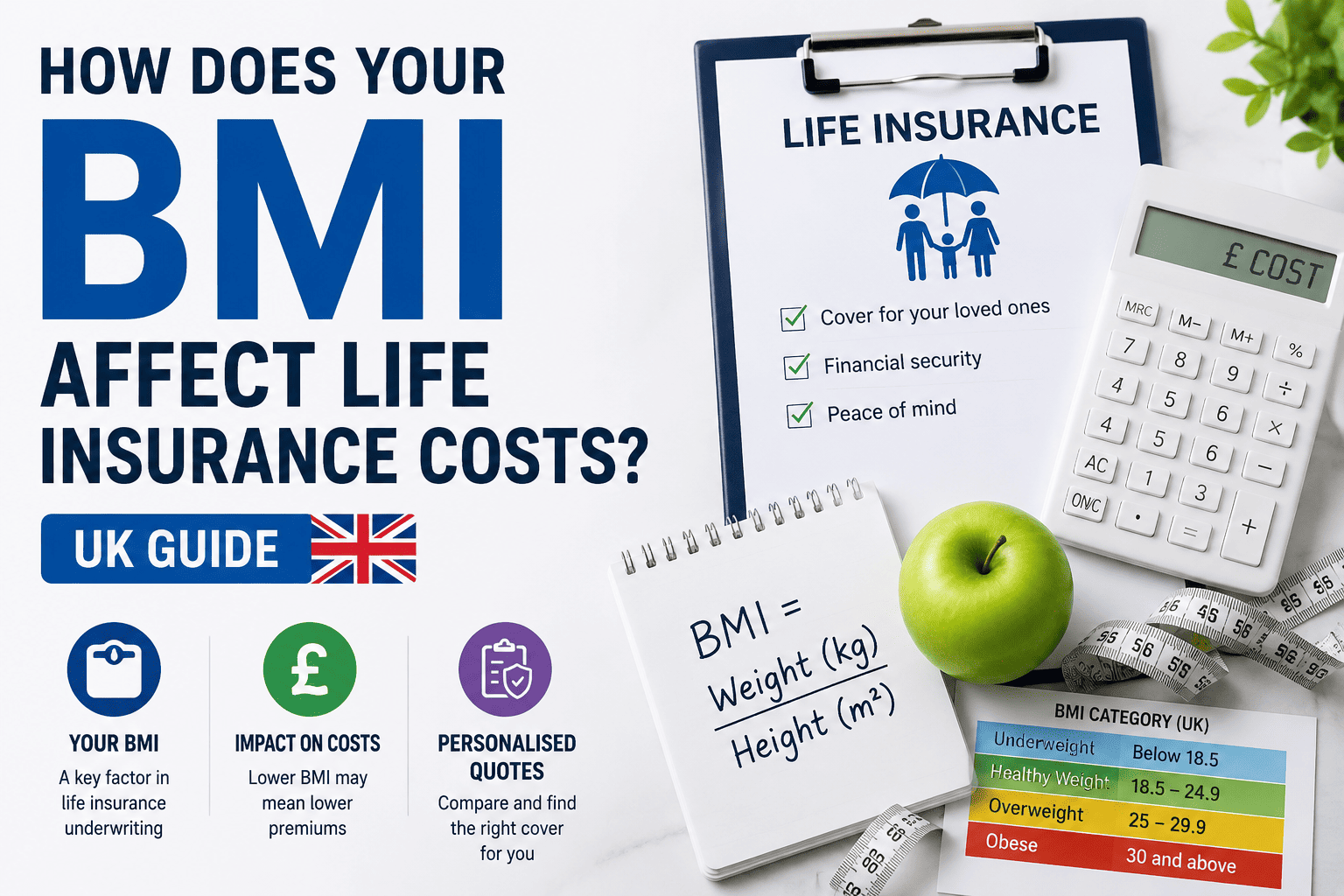
Let’s talk about the one question on the life insurance application that makes almost everyone wince. You are typing in your details, thinking about protecting your family, and suddenly you are asked to input your height and weight.
For thousands of people, this is the exact moment they abandon the quote. There is a huge misconception that carrying a few extra pounds guarantees a flat-out rejection, or that the monthly premiums will instantly become completely unaffordable.
If you are worried about your specific BMI life insurance cost UK providers are actually much more flexible than you might think. While it is true that underwriters use Body Mass Index (BMI) to measure risk, a high number doesn’t mean you can’t get excellent cover. You just need to know which companies to approach, and how their specific math works.
In this guide, we are pulling back the curtain on the underwriting process. We will look at exactly how does BMI affect life insurance, reveal the current market limits, and show you a few insider ways to keep your premiums down.
Why Do Insurers Care About BMI?
To put it bluntly, life insurance companies are obsessed with statistics. They don’t judge your appearance; they just look at the long-term medical data.
A higher BMI is statistically linked to a greater chance of developing secondary, chronic health issues later in life. Underwriters are specifically looking out for increased risks of Type 2 diabetes, high blood pressure, strokes, and cardiovascular disease. Because a heavier person is statistically more likely to claim on a policy early, the insurer charges a higher premium to offset that financial risk.
However, insurers also know the BMI scale is flawed. It doesn’t distinguish between muscle mass and fat. A professional rugby player might have a BMI of 34, classifying them as “obese,” despite being in peak cardiovascular health. If you fall into this heavily muscled category, you can easily challenge a high premium by providing a quick GP note or your waist and chest measurements.
Check Your Status: Overweight Life Insurance Calculator
Want to know exactly where you stand before you speak to a broker? Use our independent overweight life insurance calculator below. Pop in your height and weight, and our tool will generate your BMI and tell you the likely underwriting outcome for a standard UK policy.
Enter your height and weight to generate your BMI and see how standard UK life insurance providers will likely underwrite your application.
*Disclaimer: All calculations provided by this tool are estimates for informational purposes only.
Life Insurance BMI Limits 2026: The Hard Numbers
If you are looking for high BMI life insurance, the most important thing to realise is that every single provider sets their own ceiling. A BMI that gets you instantly rejected by one high-street bank might be perfectly acceptable to a different provider.
Here is how the UK market generally categorises risk in 2026:
| Your BMI Range | The Underwriter’s View | Expected Premium Impact |
|---|---|---|
| 18.5 to 29.9 | Healthy to Overweight | Standard Rates. Assuming you have no other health issues, you should pay the normal advertised price. |
| 30 to 39.9 | Obese | Premium Loading. Expect the insurer to add a percentage increase to the base price. This usually starts around a 25% hike and climbs as the BMI approaches 40. |
| 40 to 45.0 | Severely Obese | High Risk. Many mainstream providers (like Aviva or Legal & General, who cap out around 39) will decline you. You will need providers like Royal London or Scottish Widows, with expected price hikes of 50% to 100%+. |
| 45+ | Specialist Territory | Broker Required. You will need to use specialist insurers like The Exeter (limits up to 55) or Pulse (limits up to 60). A medical screening is usually required. |
How to Get Cheaper Cover with a High BMI
Just because you carry extra weight doesn’t mean you have to accept the very first inflated quote you are handed. Here is how you can proactively force the cost down.
1. Prove Your Secondary Health is Perfect
If your BMI is 35, but you are a non-smoker with textbook blood pressure, perfect cholesterol, and no family history of heart disease, you hold strong cards. An independent broker can take this complete health profile to an underwriter and negotiate the “weight loading” down significantly.
2. The Waiting Game (Weight Loss Rules)
If you have recently lost a lot of weight, congratulations. However, do not apply for life insurance the week you hit your target. Insurers are deeply skeptical of crash diets. Almost all UK underwriters require your weight to have been stable for at least 6 to 12 months before they will calculate your premium based on the new, lower weight.
3. Step Away from Comparison Sites
If your BMI is over 35, standard comparison sites are your worst enemy. Their algorithms are brutal and black-and-white. If you trigger an automated decline on a comparison site, that rejection goes on your record. Instead, use a human, whole-of-market broker. They know exactly which providers are “lenient” on weight this month and can place your application safely without risking a formal decline.
Frequently Asked Questions (FAQ)
Will an insurer actually check my weight?
You operate on trust during the initial application. However, if your BMI is borderline, or if you apply for a very large sum of money (e.g., over £500,000), the insurer may request a routine nurse screening or a report from your GP. If you lied on the application and unfortunately pass away, the insurer can refuse to pay out the money to your family due to “non-disclosure.” Always be honest.
Can I get life insurance if I am underweight?
Yes, but being severely underweight (a BMI below 18.5) triggers the same alarm bells for insurers as being obese. It can indicate underlying health issues like an overactive thyroid, eating disorders, or digestive diseases. You may face premium loadings or be asked for a medical report.
If I lose weight later, can I get my premiums reduced?
Usually, no. Standard life insurance policies are locked in at the price you agreed to on day one. However, if you lose a significant amount of weight and keep it off for a year, you can simply run a fresh quote with a new provider. If the new quote is drastically cheaper, you can take out the new policy and cancel the old, expensive one.