
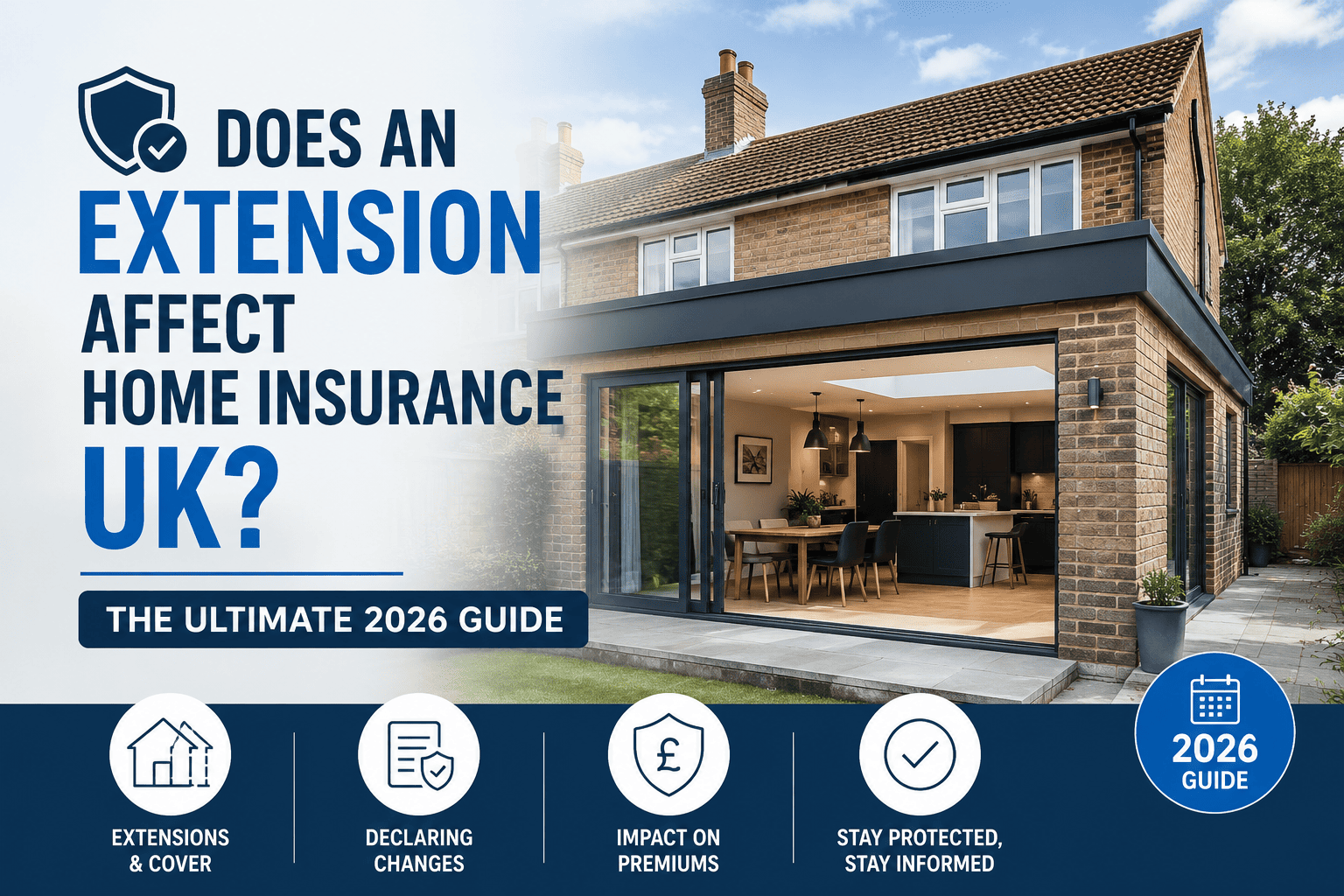
If you are planning to expand your home in 2026, you are part of a massive shift in the UK property market. With moving costs including stamp duty, legal fees, and estate agent commissions continuing to soar, thousands of homeowners are opting to “improve, not move.” From sleek single-storey kitchen wrap-arounds to expansive double-storey additions and loft conversions, extending your property is a fantastic way to add both valuable living space and long-term equity.
However, amidst the excitement of finalising architectural drawings, choosing bi-fold doors, and debating floor tiles, one critical administrative task is frequently forgotten until it is entirely too late: updating your home insurance policy.
Failing to notify your insurance provider about a home extension is one of the most common and devastating ways UK homeowners accidentally invalidate their policies. If a disaster strikes while the builders are in, whether it is a burst water main flooding your new kitchen, a structural collapse, or a fire caused by faulty new wiring, you could be left completely unprotected. This means facing tens of thousands of pounds in out-of-pocket repair bills.
This guide walks you through how home renovations affect your insurance. We will cover what you need to tell your provider, how specific architectural choices affect your premiums, and the hidden “ripple effect” risks you need to watch out for across all your other insurance policies before the builders even arrive.
Chapter 1: The Core Rule of Disclosure (Before You Break Ground)
Home insurance is meticulously calculated based on risk. When you initially took out your policy, your underwriter calculated your premium based on the exact, static specifications of your home at that very moment: the number of bedrooms, the type of roof, the quality of the door locks, and the overall rebuild cost. When you start an extension, the risk profile of your property changes drastically overnight.
The Utmost Good Faith Clause
UK insurance policies operate on the legal principle of uberrima fides, which translates to “utmost good faith.” You are legally obligated to disclose any material changes in your circumstances that could increase the likelihood of a claim. If a builder knocks down a load-bearing wall, your home is temporarily less secure and structurally vulnerable. If scaffolding is erected, burglars have an easy ladder to your upper floors. If you haven’t informed your insurer of these increased risks, they have every right to refuse a claim or cancel your policy altogether.
How and When to Notify Your Insurer
You must contact your insurer at the planning stage, ideally a minimum of four to six weeks before any builders arrive on site. Do not wait until the skips are on the driveway. If you are unsure of exactly what details to provide to your underwriter, it is best to do it in writing to maintain a paper trail. We have created a comprehensive template on exactly how to structure your letter to your insurance company for a home extension. Providing written notice ensures there is no ambiguity regarding what you disclosed.
Chapter 2: Types of Extensions and Their Specific Insurance Impacts
Not all extensions are viewed equally by insurance underwriters. The specific architectural and structural choices you make will dictate how your policy reacts. Here is a breakdown of how different build types affect your coverage.
Flat Roof Kitchen Extensions
Flat roofs are incredibly popular for modern, open-plan rear extensions. However, insurers are notoriously wary of them. Because flat roofs do not drain water as efficiently as pitched roofs, they are far more susceptible to water pooling, freeze-thaw weather damage, and eventually, catastrophic leaks. Your insurer will demand to know the exact percentage of your home’s total roof area that is now flat, and what materials are being used. Traditional felt is cheap but frowned upon; EPDM rubber or fibreglass is preferred. To understand exactly how this affects your premiums, read our dedicated breakdown on flat roof extension home insurance in the UK.Leasehold Properties and Flats
Extending a leasehold property, such as a ground-floor flat into a garden, is a legal and insurance minefield. You do not just have to worry about your own contents; you have to consider the freeholder’s overarching buildings insurance and the structural integrity of the flats above yours. Before proceeding, you must obtain a formal ‘License to Alter’ from your freeholder, and you may be forced to pay for a specific indemnity policy. The insurance dynamics change significantly when you don’t own the land. Ensure you fully understand the strict rules by reading our guide: do you need home insurance for a leasehold flat in the UK?Loft Conversions and Cellar Dig-Outs
While a loft conversion may not extend the actual footprint of your property, it drastically alters the “rebuild cost” (which we will cover later). It also increases the number of habitable rooms—specifically bedrooms and bathrooms. Insurers base premiums heavily on bedroom count, as a 4-bedroom house statistically holds more high-value contents and family members than a 3-bedroom house. Cellar excavations carry the highest risk of all due to subsidence and underpinning requirements, often requiring completely separate, specialist site insurance.
Chapter 3: The Danger Zone — Managing the Active Building Phase
The period when builders are actively working on your property is the highest-risk timeframe. Standard UK buildings and contents insurance usually covers everyday domestic living, not an active construction site with power tools, heavy machinery, and exposed brickwork.
1. Unoccupied Property Clauses
Will you be moving out to escape the dust, noise, and lack of plumbing? Standard UK home insurance policies universally contain an “Unoccupied Clause.” This means your policy becomes invalid if the property is left vacant for more than 30 (or sometimes 60) consecutive days. If you are renting an Airbnb elsewhere for a four-month build, your standard policy is useless. You will likely need to switch to specialist “Unoccupied Property Insurance.”
2. Security Risks, Scaffolding, and Forced Entry
If your insurer agrees to continue your coverage while you remain living in the house during the build, they will almost certainly add a “restrictive endorsement.” Because builders are coming and going, doors will be left open. Scaffolding provides easy access to upstairs windows. Therefore, the insurer will state they will not cover theft unless there is physical evidence of violent and forced entry. If a builder leaves the back door ajar and someone walks away with your television, your claim will be denied.
3. Understanding Liability: Yours vs. The Builder’s
Before anyone lifts a sledgehammer, you must establish who is liable for what. Never hire a builder without seeing copies of their insurance certificates.
| Risk Scenario | Who Should Be Covered? | Type of Insurance Required |
|---|---|---|
| A builder drops a steel RSJ beam on your neighbour’s parked car. | The Builder | Contractor’s Public Liability Insurance |
| An employee of the builder falls off scaffolding and is injured. | The Builder | Employer’s Liability Insurance (Legally required) |
| The builder goes bankrupt midway through a £60,000 extension. | The Homeowner | Non-Performance / Contract Works Insurance |
| A visiting friend trips over building materials left on your driveway. | The Builder / Homeowner | Public Liability (Check both policies carefully) |
For official UK guidance on liability during home renovations, the Health and Safety Executive (HSE) provides excellent free resources for “domestic clients.”
Chapter 4: The Ripple Effect — How Renovations Impact ALL Your Insurance
A major home extension does not just affect the bricks and mortar; the chaos ripples out into every single aspect of your daily life. When your home is turned upside down, your overall risk profile shifts across the board. Savvy homeowners use a major renovation as a trigger point to review all their active insurance policies. Here is how a house extension affects other areas of your life.
1. Car Insurance: The Driveway Dilemma
It sounds bizarre, but a home extension can invalidate your car insurance. How? It comes down to parking. If your driveway is taken up by a skip, a cement mixer, pallets of bricks, and builders’ transit vans, you will likely have to park your family car on the street.
If your car insurance policy specifically states that your vehicle is kept “on a private driveway overnight,” parking it on a public road represents a breach of contract. Street parking has a higher risk of vandalism, wing-mirror clippings, and theft. You must update your insurer about your temporary parking status. While doing so, it is wise to review exactly what fully comprehensive car insurance actually covers regarding street-parking damage.
2. Motor Risk: The DIY Supply Run
During a build, you will inevitably find yourself making endless weekend trips to B&Q, Wickes, or local timber merchants. Often, homeowners rope in younger family members—like university-aged children—to drive a second car or a borrowed van to help fetch bulky supplies. Ensure they are adequately covered for these supply runs, keeping a close eye on the average car insurance cost for a young driver if you need to add them as a named driver temporarily.
Furthermore, rushing back and forth to merchants during your lunch break leads to careless driving. The stress of managing a build can cause lapses in concentration. Do not let the stress of a late cement delivery land you with penalty points; a single mistake can be financially painful. Find out exactly how much an SP30 speeding ticket increases your car insurance before you rush to the shops.
3. Protecting Family Belongings in the Chaos
With multiple subcontractors (electricians, plumbers, plasterers) walking through your home daily, the security of your high-value portable items is severely compromised. If you have older children or students living at home, their expensive laptops, iPads, and gaming consoles are at massive risk—not just from potential theft, but from fine plaster dust, water leaks, or being knocked off tables by shifting furniture.
Because your standard home contents insurance might be restricted during the build, it is a highly recommended strategy to ensure their vital tech items are individually protected. You can explore standalone, comprehensive options in our guide to student gadget insurance in the UK, which covers accidental damage and loss regardless of what is happening to the house itself.
4. Pet Safety and Veterinary Risks
Construction sites are absolutely terrifying for domestic pets. The sudden introduction of loud masonry drills, strangers in high-vis jackets, and the constant opening and closing of exterior doors create a perfect storm for a pet to panic. Dogs and cats are highly prone to escaping during renovations, or worse, injuring themselves by stepping on exposed nails, swallowing dropped screws, or getting into toxic building materials like adhesives.
Emergency vet bills for accidents or stomach pumping can easily spiral into thousands of pounds. If you have a sensitive, high-value, or anxiety-prone breed, ensure your pet cover is premium and up to date. For context on how rapidly veterinary costs can escalate for specific breeds in emergency situations, see our breakdown of French bulldog insurance costs in the UK.
5. Escaping the Dust: Travel Insurance Considerations
Living through a “knock-through” (when the external wall of your house is removed to join the new extension) is incredibly stressful. There is usually a two-week period where your home is exposed to the elements, freezing cold, and covered in thick dust.
Many families, particularly those with older relatives, choose to go on holiday for the messiest weeks of the build to escape the chaos. If you or older family members are planning a strategic getaway to the sun while the builders do the heavy lifting, ensure your travel policies are fully sorted in advance, especially as premium calculation methods change significantly with age. Check out our latest 2026 data on over 70 travel insurance costs in the UK to ensure peace of mind while away.
Chapter 5: Post-Completion – Rebuild Costs and Estate Planning
UK Extension Rebuild Cost Estimator
Calculate how much your new extension will add to your home's total insured rebuild cost.
*Disclaimer: All calculations provided by this tool are estimates for informational purposes only.
Once the dust has settled, the paint is dry, and the local council has issued your Building Regulations Completion Certificate, you might think the paperwork is over. However, the completion of an extension triggers the most important insurance update of all.
The Underinsurance Trap (Rebuild vs. Market Value)
You must immediately update your home insurance with your new rebuild cost.
A common misconception is that home insurance is based on the market value of your property (what you could sell it for). It is not. It is based on the rebuild cost the exact amount of money it would cost to hire contractors to demolish a burnt-down site and rebuild the house from scratch, including labour, materials, and architectural fees.
Adding a large extension adds tons of brickwork, roofing, plumbing, and wiring. This inherently increases the rebuild cost. If you fail to increase your insured rebuild cost after an extension, you will be deemed “underinsured.”
The Condition of Average: If your home’s true new rebuild cost is £400,000, but your old policy only insured it for £200,000 (50% of its actual value), the insurer will apply the ‘Condition of Average’. If you later make a claim for a £40,000 kitchen fire, the insurer will only pay out £20,000 (50% of the claim), leaving you £20,000 in debt. Always ask your architect or a surveyor to calculate your new rebuild cost.
Life Insurance and Mortgage Protection
Finally, look at the big picture. When your extension is complete, the total equity and value of your estate will have significantly increased. Often, homeowners finance an extension by remortgaging or taking out further advances against the property. A larger, more valuable property with a larger mortgage means your family’s financial liabilities have increased.
Major financial life events like a remortgage and extension should act as an automatic prompt to review your life insurance and critical illness cover. You must ensure your policy covers the new, higher value of your mortgage so your family isn’t left short or forced to sell the newly extended home if the worst happens. When updating these policies, underwriters will look at your current health metrics, which may have changed since you bought your first home. Take the time to review how your BMI affects life insurance costs in our 2026 UK guide to ensure you get the best rates.
Chapter 6: Your 4-Step Extension Insurance Checklist
To ensure you remain on the right side of the law and fully protected financially, follow this chronological checklist:
- Phase 1: Planning (2-3 Months Before)
- Calculate an estimated new rebuild cost with your architect.
- Check the Party Wall Act requirements if building near a boundary. You can find official guidance on the UK Government’s Party Wall portal.
- Call your current home insurance provider to ask if they cover properties undergoing structural alteration (many do not, meaning you will need temporary Site Insurance).
- Phase 2: Pre-Construction (2-4 Weeks Before)
- Request physical copies of your builder’s Public Liability and Employer’s Liability insurance.
- Confirm temporary living arrangements; update the insurer if the property will be unoccupied.
- Secure high-value gadgets, update pet microchips, and move cars off the driveway.
- Phase 3: The Active Build
- Enforce a strict “doors and gates locked” policy with the contractors at the end of every day.
- Ensure all building materials are stored securely so they do not become a trip hazard or a target for theft.
- Phase 4: Completion
- Obtain your official Building Regulations Completion Certificate from the council.
- Contact your insurer to confirm the works are 100% finished.
- Formally update the exact final rebuild cost and the new number of bedrooms on your permanent policy.
Conclusion: Protect Your Investment
Building an extension is arguably one of the most rewarding investments you can make in your UK property. It transforms the way you live and adds massive value to your estate. However, the financial risks of navigating a building site with an invalidated insurance policy simply aren’t worth ignoring.
Transparency is your absolute best tool. Tell your insurer exactly what you are doing, when you are doing it, and who is doing the work. By keeping your provider in the loop and ensuring your wider life from your cars and pets to your family’s gadgets is adequately covered during the chaos, you can enjoy the building process knowing your hard earned investment is entirely secure.