
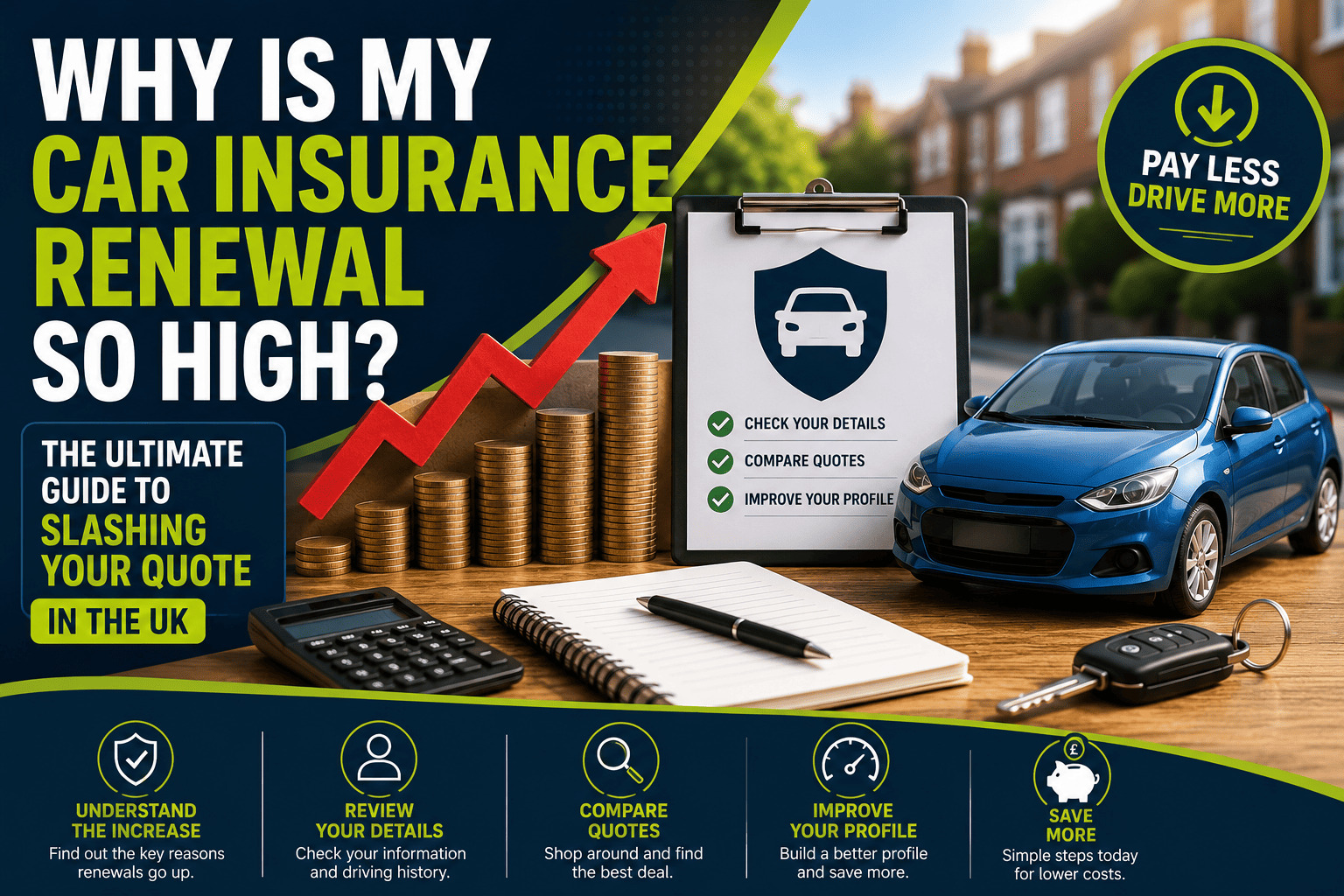
It happens every single year. You receive an email or a letter with a subject line like “Your upcoming policy documents.” You open it, scan past the legal jargon, and look straight for the total price. Your heart sinks. It has gone up again. And not just by a few pounds—it is often a massive, inexplicable leap. You haven’t had a crash. You haven’t made a claim. You haven’t even received a speeding ticket. In fact, your vehicle is another year older and arguably worth less on the open market. So, naturally, you are left staring at the screen, frustrated and wondering: why is my car insurance renewal so high?
If you are feeling a sense of renewal shock right now, you are absolutely not alone. Millions of motorists across the UK experience this exact same frustration every month. Insurers rely heavily on the fact that modern life is incredibly busy. They build their business models on the assumption that you will glance at the quote, feel a brief moment of intense annoyance, but ultimately let the policy roll over because the thought of switching feels like too much of an administrative headache. This phenomenon is known in the industry as the “convenience tax,” and it is costing British drivers hundreds of pounds a year.
This comprehensive, step-by-step guide is designed to help you fight back. We will break down exactly what drives a modern car insurance renewal increase, explain the psychology behind how providers price their loyal customers, and give you the exact strategies and negotiation scripts you need to slash your premium. Most importantly, we will show you how to take back control of your motoring expenses.
Why Is My Car Insurance Renewal So High? The Hidden Factors
When you see a drastically inflated price, it feels incredibly personal. It feels as though the insurer is punishing you specifically. But the reality is far more clinical. The number on your renewal document is simply the output of a highly sophisticated algorithm. This algorithm is built to calculate two main things: the projected cost of repairing vehicles in the current UK economic climate, and precisely how much of a price hike you are willing to tolerate before you finally decide to leave.
Here are the primary, industry-wide reasons you are seeing such a massive hike on your current policy:
- The Astronomical Cost of High-Tech Vehicle Repairs: Modern cars are essentially rolling computers. A minor fender bender ten years ago meant replacing a piece of molded plastic and perhaps a metal bracket. Today, that exact same front bumper contains parking sensors, radar units for adaptive cruise control, pedestrian detection cameras, and intricate wiring looms. When you bump a modern vehicle—especially modern Electric Vehicles (EVs) which have strict battery safety protocols—the repair bill is astronomical. Insurers are passing these cumulative industry costs directly onto the consumer base. Even if you personally drive a straightforward, ten-year-old hatchback with zero technology, your premium goes up to subsidize the cost of repairing the luxury SUVs that share the road with you.
- Supply Chain Delays and the Courtesy Car Trap: Getting replacement parts into the UK takes much longer than it used to. If your car is in the garage for six weeks instead of six days because a specific microchip or body panel is stuck in transit, the insurer has to pay the daily rate for your courtesy rental car for that entire extended period. This dramatically inflates the cost of even minor claims across the board.
- Hyper-Local Risk Profile Changes: Insurers constantly, aggressively update their macro data. If there has been a recent spike in vehicle thefts (such as keyless entry relay thefts), localized vandalism, or severe traffic accidents in your specific postcode, the algorithm will instantly flag your address as a higher risk zone. Your personal driving record could be completely flawless, but if your neighbors are crashing their cars or having them stolen, your premium absorbs the localized shock.
- The Long-Term Impact of FCA Pricing Rules: In 2022, the Financial Conduct Authority (FCA) implemented strict new pricing rules. They officially banned “price walking”—the historically common practice of offering dirt-cheap, loss-leading introductory rates to brand new customers, and funding those discounts by quietly hiking prices for loyal customers year after year. While this legislation was meant to make the market fairer overall, the unintended consequence is that insurers simply no longer offer those aggressive, cheap introductory discounts. The baseline rate for absolutely everyone has shifted upward.
Understanding the Average Car Insurance Renewal Increase
Before you pick up the phone in anger, you need to arm yourself with context. Is your quote just a standard adjustment for national inflation, or are you actively being taken for a ride by a greedy provider?
Determining the average car insurance renewal increase requires looking at the broader market. Data from the Association of British Insurers (ABI) frequently shows average comprehensive premiums fluctuating significantly quarter by quarter. When the insurance market “hardens”—due to spikes in repair costs, a rise in uninsured drivers, or general economic inflation—it is entirely normal for the national average premium to tick up by 5% to 10%.
Horizontal market conditions mean that if your personal quote has jumped by 20%, 30%, 40%, or even 50% with absolutely no changes to your personal circumstances (no points, no claims, no change of address or vehicle), you are sitting well above the industry average. At that point, the insurer’s algorithm is simply testing your apathy to see if you will accept a loyalty penalty.
Calculate Your Renewal Increase Percentage
Use our free tool below to calculate your exact percentage increase. Find out instantly if your price hike is a standard inflation adjustment or a hidden loyalty penalty:
Universal Insurance Renewal Calculator
Works for any policy. Enter your details below to see if your price hike is fair or if you are being overcharged.
*Disclaimer: All calculations provided by this tool are estimates for informational purposes only.
Does It Actually Help to Complain About Insurance Renewal Price?
When faced with a bill that seems unjustifiably high, human nature takes over. Many drivers assume the logical first step is to call the customer service helpline and angrily complain about insurance renewal price.
Here is the harsh, insider truth: venting your frustrations to a frontline call center representative will get you almost nowhere. The person on the other end of the telephone line does not set the prices. They are bound by a rigid computer system and are completely immune to emotional arguments about your ten-year loyalty to the brand, or how safely you drive.
They are provided with a very strict script and an incredibly narrow margin of authority to offer token discounts based purely on a customer complaint. If you just call to complain, they might knock £20 off the premium as a “goodwill gesture” to placate you, hoping you will accept it and hang up.
Complaining is a passive action. Negotiating, on the other hand, is an active strategy. If you genuinely want to drop the price by a significant margin, you have to separate your emotions from the process and treat it strictly as a business transaction. You need leverage, and in the insurance market, the only true leverage you possess is a cheaper, fully finalized quote from a direct competitor.
Note: If you believe your insurer has actually made a factual error (e.g., recording a fault claim that was actually non-fault), that is a different matter. In those cases, you should make a formal complaint and escalate it to the Financial Ombudsman Service (FOS) if they refuse to correct your data.
How to Negotiate Car Insurance Renewal Like a Pro
You can routinely shave hundreds of pounds off an inflated renewal quote with a single, well-prepared phone call. However, you must follow the correct process. Do not call your current provider until you have completed the first two critical steps below. Here is exactly how to negotiate car insurance renewal to get the absolute best possible outcome.
Step 1: Gather Your Leverage Using the 21-Day Rule
Timing is everything. Statistically, the cheapest time to get a car insurance quote is exactly 21 to 23 days before your current policy is due to expire. Algorithms view drivers who plan ahead as statistically safer, lower-risk individuals. Drivers who wait until the day before renewal are viewed as rushed, higher-risk, and desperate, and they are priced accordingly.
Open at least three different comparison engines (such as Compare the Market, Go.Compare, and Confused.com). Different comparison sites have different exclusive underwriting deals, so the prices will vary. Enter your exact details and find the absolute cheapest like-for-like quote. Write down the precise price, the excess amounts, and the name of the new provider.
Step 2: Optimize Your Details Legally
How you describe your job profoundly impacts your premium risk profile. A “Chef” might pay a completely different rate than a “Cook.” A “Journalist” usually pays significantly more than a “Copywriter.” Use a free online job title tweaking tool to find the cheapest legitimate way to describe what you do for a living. Crucial warning: Never lie. Lying about your job is insurance fraud and will void your policy entirely. But you are perfectly entitled to select the most favorable accurate description from their drop-down list.
Step 3: Bypass Standard Customer Service
Call your current insurer. Do not go through the general customer service menu. Instead, listen closely to the automated prompts and select the option for “thinking of leaving us,” “cancellations,” or “policy closure.” This specifically routes your call directly to the retention team. Unlike standard customer service agents, the retention team’s specific, targeted job is to save lost business. Because of this, they are granted the highest level of authority to apply discretionary discounts to keep you on the books.
Step 4: Deliver the Negotiation Script
Keep your tone entirely polite, calm, but very firm. Use this exact phrasing:
“Hello. I recently received my renewal quote of £[Insert Your High Quote], but I have just run a full market comparison and [Insert Competitor Name] is offering me the exact same level of comprehensive coverage for £[Insert Cheaper Quote]. I have been very happy with your customer service over the last year, and I would honestly prefer not to go through the hassle of switching providers today. Can you match this price to keep my business?”
At this point, the retention agent will usually put you on hold, run your file through their system, and come back with a newly reduced number.
- If they match the competitor’s price, you win. Accept it.
- If they meet you halfway, you have to decide if the minor savings are worth the hassle of setting up a new direct debit, learning a new app, and downloading new documents elsewhere?
- If they rigidly refuse to budge entirely, you must confidently follow through on your threat. It is time to walk away.
The Final, Vital Step: Cancel Auto Renewal Insurance
If your current provider refuses to drop the price to a reasonable level, you cannot just ignore their letter, throw it in the bin, and buy a new policy with someone else online. This is a trap that catches thousands of motorists every year.
Unless you actively, explicitly intervene, almost all modern UK car insurance policies will roll over automatically. If you simply assume the policy will end and you buy a second policy with a new company, you will be billed twice. Having dual insurance creates an absolute nightmare if you ever need to make a claim (as both companies will argue over who is responsible for paying), and recovering the money from the unwanted auto-renewed policy usually incurs hefty administrative cancellation fees.
You must take the time to explicitly cancel auto renewal insurance with your current provider.
- Check the Exact Expiry Deadline: Look very closely at your renewal letter. It will state the exact date and time your current policy expires (this is almost always 23:59 on a specific date).
- Turn Off the Digital Toggle: Most major UK insurers now allow you to disable the auto-renewal feature directly within their mobile smartphone app or their online customer portal. Log in, navigate to your policy settings, and look for a toggle switch marked “automatic renewal.” Switch it to the ‘off’ position.
- Get Iron-Clad Written Confirmation: If your provider is older and forces you to call them to cancel, do so. But do not just take the phone agent’s word for it. Insist that they trigger an automated email confirming that the auto-renewal has been successfully canceled while you are still on the line.
- Time Your New Policy Perfectly: Set your new, cheaper policy to begin on the exact date and time your old one expires. Do not leave a gap of even a single day. Driving without continuous insurance coverage in the UK is a strict liability offense; a lapse will quickly get you pulled over by police using Automatic Number Plate Recognition (ANPR) cameras, resulting in six penalty points and a £300 fine.
Additional Advanced Tactics to Force Your Premium Down
If you have negotiated, shopped around, and optimized your job title, but the baseline market price is still too painful for your budget, you need to fundamentally change the variables of the policy itself to lower the risk algorithm’s final output.
- Pay Annually, Not Monthly: This is the biggest hidden cost in insurance. Paying monthly is not a convenience subscription like Netflix; it is a high-interest credit agreement. Insurers effectively lend you the annual cost and charge you upwards of 20% to 30% APR for the privilege of paying it back over 12 installments. If you cannot afford the upfront lump sum, take out a 0% purchase credit card, pay the insurer in full with the card, and then pay the card off over the year to pocket the massive interest savings.
- Increase Your Voluntary Excess (Carefully): The higher the voluntary excess (the amount of your own money you agree to pay out of pocket before the insurance company pays a penny towards a claim), the lower your annual premium will be. Bump it up to £500 to see significant savings. However, never set it higher than the actual liquid savings you have in your bank account. If you crash and cannot afford the excess, your car will not be repaired.
- Add an Experienced Named Driver: If you are a younger driver, or a driver who has recently accumulated points on your license, adding an older, highly experienced driver (like a parent, older sibling, or partner with a clean driving record) to your policy can bring the average risk profile of the vehicle down. Crucial rule: They must legitimately use the car occasionally. Do not list them as the ‘main’ driver if they are not—that is an illegal practice called “fronting,” which will result in your policy being cancelled and potential prosecution.
- Strip Away the Fluff: When you generate a quote, insurers will automatically pre-select profitable “add-ons” like breakdown cover, legal protection, courtesy car upgrades, and lost key cover. Uncheck every single one of these boxes. You can usually buy breakdown cover and standalone legal cover far cheaper from a third-party provider than buying it directly as an add-on from your main motor insurer.
Dealing with motor insurance companies is ultimately a game of financial attrition. They make their biggest profit margins off the drivers who are too busy, too stressed, or too confused to look closely at their mail and challenge the yearly hike. By understanding the underlying data, gathering your competitive leverage, taking control of the auto-renewal settings, and being entirely willing to walk away from a bad deal, you can successfully take back control of your motoring costs year after year.