
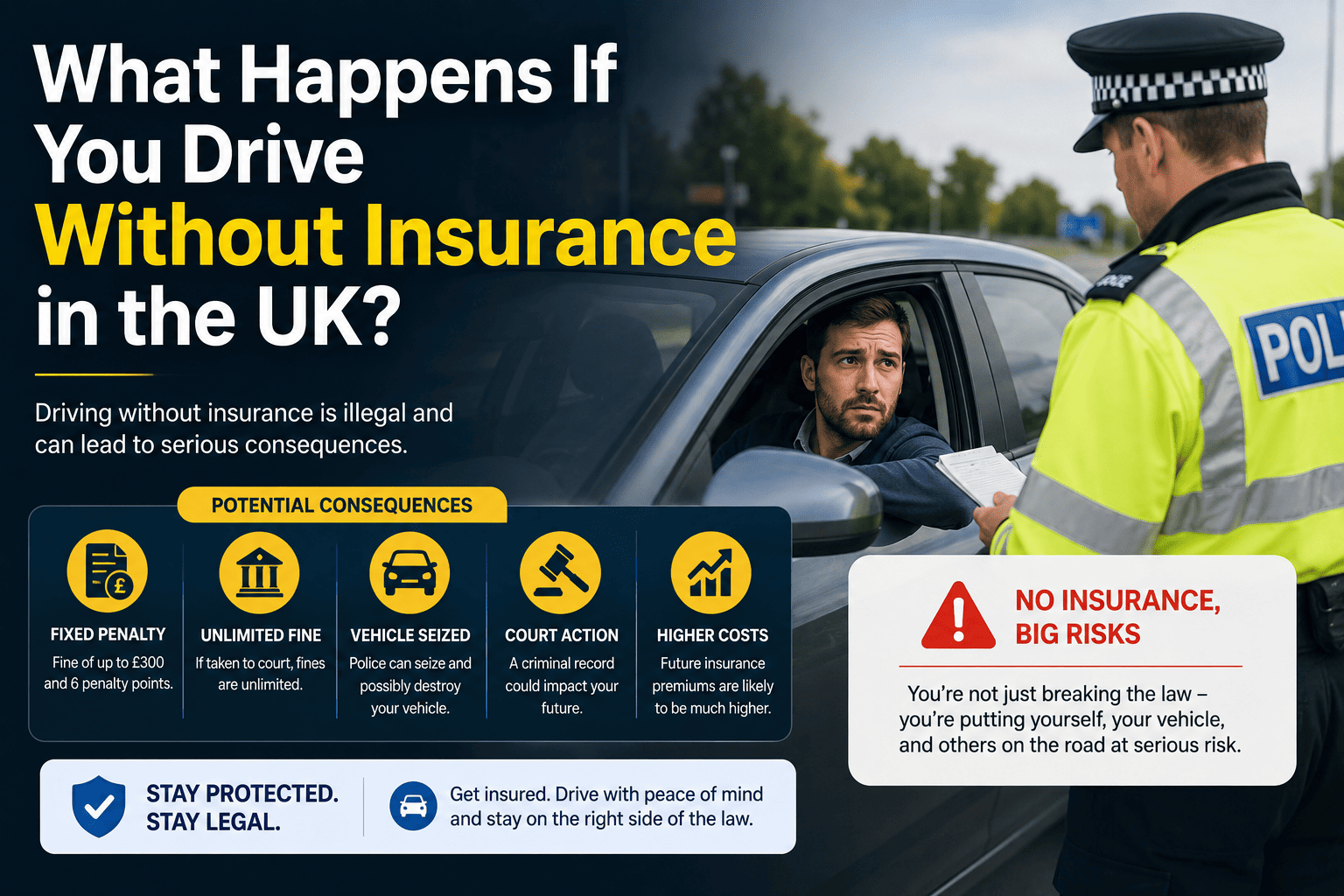
You’re halfway to work when blue lights show up in your rearview mirror. The officer checks your registration, asks who insures the car – and then you remember your policy expired yesterday. It might have been a missed email, a failed direct debit or even an incorrect start date, but the real issue right now is exactly the same: driving without insurance UK law treats your vehicle as uninsured whenever you’ve actually used it.
The results could go way beyond just paying a fine. You might receive penalty points, lose your vehicle at the roadside, face court proceedings – and pay more for insurance cover for many years after that. For a new driver, six points can also mean starting the entire licensing process all over again.
Is Car Insurance a Legal Requirement in the UK?
Indeed, GOV.UK affirms that you really must have motor insurance prior to driving on UK roads – and third party cover is actually the legal minimum required. Your policy must apply to the driver, the vehicle itself – and the manner in which it’s being used. Holding an insurance certificate for a different vehicle, or being insured only for social purposes whilst making deliveries doesn’t automatically render the drive lawful.
There is a separate rule for vehicles that are not being driven. In Great Britain, a registered vehicle normally needs continuous insurance unless it is kept off the road and declared SORN (Statutory Off Road Notice). The uninsured vehicle rules uk enforce specific regulations that differ from being caught behind the wheel, with separate penalties for the registered keeper regardless of active movement.
The Penalty for Driving Without Insurance in the UK
The severity of consequences changes depending on whether your case is handled at the roadside via a fixed penalty notice or elevated directly to a regional magistrates’ court:
| Outcome | England, Scotland & Wales | Northern Ireland |
|---|---|---|
| Roadside fixed penalty | £300 fine & 6 penalty points | £200 fine & 6 penalty points |
| If the case goes to court | unlimited fine, 6 to 8 points or discretionary disqualification | unlimited fine, 6 to 8 points or discretionary disqualification |
| Vehicle | police can seize it & may ultimately destroy it | police can seize it pending proof of valid insurance & other documents |
| Driving record | IN10 endorsement normally remains for 4 years from the offence | no-insurance endorsement normally remains for 4 years from the offence |
Great Britain’s figures can be found on GOV.UK and Police.uk. Northern Ireland operates a different fixed penalty, confirmed by the Police Service of Northern Ireland. A fixed penalty is not always an option. More serious cases, repeat offenders, accidents, false information or other offences might take someone directly to court.
Get Your Vehicle Insurance Estimate Quote
Don’t risk driving uninsured. Secure reliable cover today or run a policy estimate below to protect your vehicle and your licence:
vehicle Insurance Quote Engine
What Happens at the Roadside?
Police can check the Motor Insurance Database (MID) using the vehicle registration before they stop you. If the database shows no cover, you may be asked to produce some evidence on your phone or contact your insurer. A recent policy may not yet appear on the database – so your certificate, schedule and payment confirmation will matter a lot.
If there is no valid cover, the car could be seized under police powers. This leaves you arranging recovery, storage and proof of a new policy before the vehicle is released. Driving further with a known issue may actually make everything much more serious.
Does an Honest Mistake Make a Difference?
The Reality of Strict LiabilityDriving without insurance UK might be an honest mistake, but it won’t always make the offense just vanish. Actual conversations on r/LegalAdviceUK often repeat themselves in similar ways all the time: a policy started at midnight rather than right away, a named driver was left off a renewal, or a payment failed and thus cancelled. |
Documenting Your DefenseThe driver might really have meant no harm and had no plan to break the law itself – yet the key question really is if a valid policy actually did cover that specific trip. Evidence will still be important. Be sure to save the policy documents, emails, call recordings, bank statements, and screenshots of what you were ever told. |
If an insurer or broker made some sort of error, complain right away – and ask for something in writing. If you get a fixed fine or even court papers and are quite convinced there was coverage, try to seek out legal advice first before making your next move.
Why Six Points Can Be Devastating for New Drivers
Under new driver penalty-point rules, a licence gets revoked when points total six or more within two years of passing your very first driving test. Since the standard no-insurance penalty is already six points, one single incident could be enough to end your driving status. You really must apply for a new provisional licence and pass both the theory and practical tests all over again before you’ll get back to full-licence status.
That’s particularly quite painful when you’re already paying very high young driver insurance costs. A revoked licence and an insurance conviction can reduce the number of insurers willing to quote – and push the remaining premiums sharply higher.
How an IN10 Conviction Affects Future Insurance
In England, Scotland and Wales, not having car insurance is recorded as an IN10 endorsement. DVLA guidelines say this is worth 6 to 8 points and stays on your driving record for four years starting from when you committed the offence. The long term driving without insurance code in10 cost penalty impact means your annual premiums are highly likely to double or triple at future renewals.
Your insurer might ask about your driving history for longer than the endorsement will be shown, so give the exact information asked for in the question. An IN10 is normally treated more seriously than a routine speeding endorsement because it suggests a failure to maintain legally required cover. Our guide to how an SP30 speeding ticket affects insurance explains why insurers price different conviction codes very differently.
The Most Common Ways Drivers Become Uninsured
- Assuming comprehensive cover includes other cars: If you are unsure how does driving other cars cover work on your policy, read the fine print. Driving other cars cover is not automatic and often has age, vehicle, and emergency-use restrictions.
- Getting the start date or time wrong: A policy bought today may start tomorrow, or at a specific time rather than immediately.
- Missing a payment or cancellation email: A failed instalment can lead to the policy being cancelled after the insurer follows its notice process.
- Using the car outside the permitted class of use: Commuting, business travel, courier work and food delivery can require different cover.
- Letting someone borrow the car without checking: The driver needs valid cover, and the person who causes or permits uninsured driving can also face action.
What To Do If You Discover You Are Uninsured
- Pull over now and park safely – don’t just finish your journey out of habit.
- Get in touch with your insurer or broker and confirm all cancellation, start or expiry times in writing.
- Arrange a valid policy before driving your vehicle again. Check your certificate, named drivers, registration details, class of use, and start time very carefully.
- Keep hold of every document if there’s ever any dispute. Never alter, backdate or invent evidence – that would be a mistake.
- Respond to police/court letters by the time frame given and seek expert legal advice whenever liability or coverage is involved.
Frequently Asked Questions
Can I drive home after the police discover I have no insurance?
No. Once you know there’s no valid cover, driving again creates another uninsured journey. Your vehicle might be taken away, or you’ll need an insured driver or a recovery service to get it moved.
Will I always receive six points?
A roadside fixed penalty usually results in six points. If the case gets to court, the typical endorsement range is 6 to 8 points, though the court has the option to disqualify you instead – especially in certain cases.
Can the police seize a car that belongs to someone else?
Yes. The power relates to the uninsured use of the vehicle itself, not just who owns it. So, the owner may have to provide proof of entitlement – and show they have valid insurance – before the vehicle is released.
Does fully comprehensive insurance allow me to drive any car?
Not necessarily. Lots of comprehensive policies don’t include driving other cars cover. Where it does exist, it might only be for third-party purposes and be subject to some very strict conditions. Always check your certificate before taking the keys out.
What if the Motor Insurance Database is wrong?
Show the officer your policy certificate, schedule, and payment records – then phone the insurer straight away. A database delay isn’t the same as not having a policy at all, but only your insurer can say for sure whether your cover was actually in effect.
The Bottom Line
Car insurance policies protect you from severe financial and legal liability on the road. The uninsured vehicle rules uk enforces mean that driving without a valid policy can completely upend your driving status and your finances in an instant.
The best policy isn’t always the one with the lowest monthly premium or the most lenient terms on paper. It’s the one that makes absolute sense—covering your specific class of use, excesses, and named drivers—the moment a real police check or a roadside emergency actually shows up.