
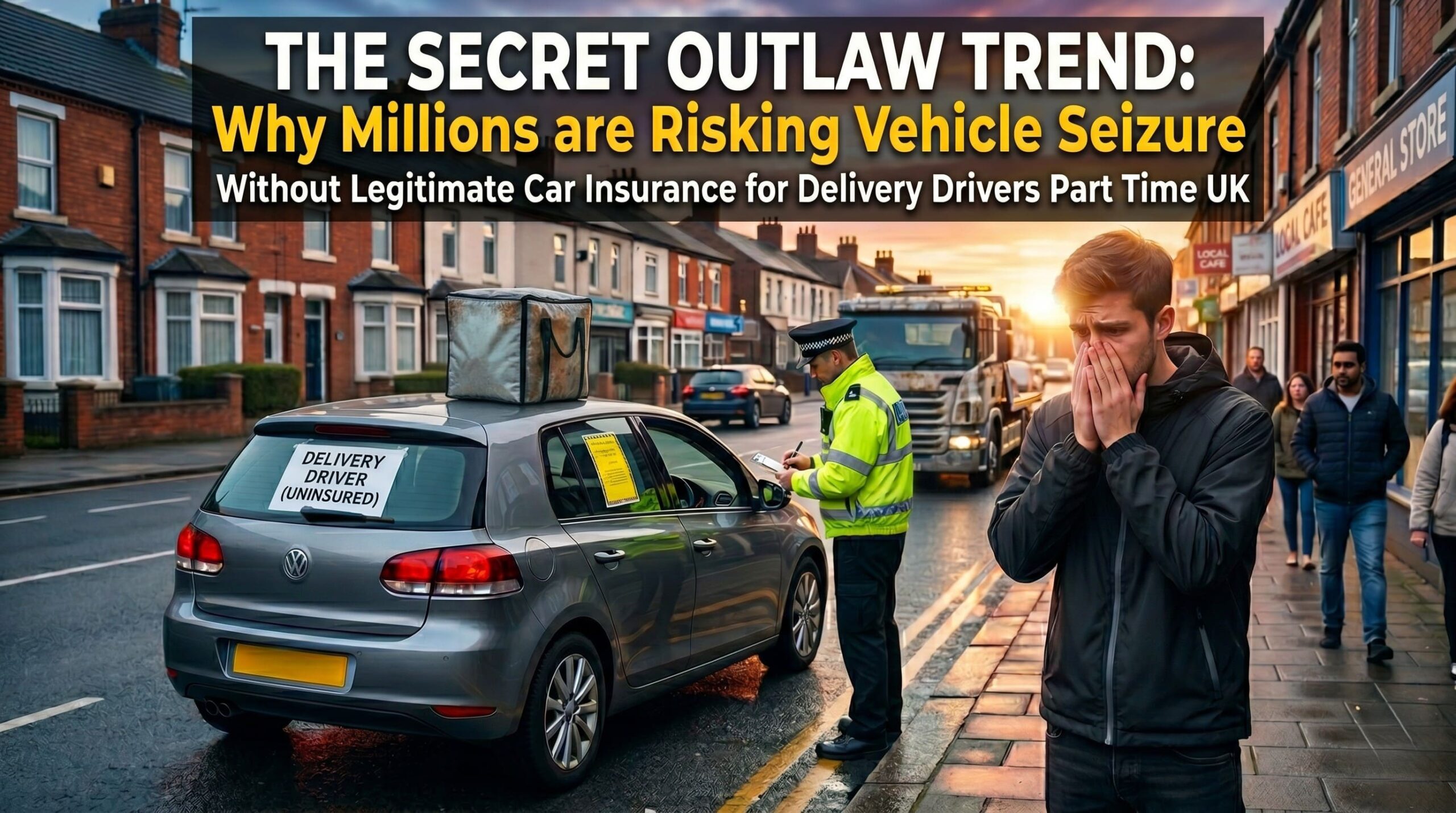
The UK’s gig economy has undergone a monumental shift over the last decade. Driving for flexible on-demand apps like Deliveroo, Uber Eats, Just Eat, Amazon Flex, or local takeaway joints has transitioned from a niche side-hustle into a primary financial safety net for hundreds of thousands of people. Whether you are a student trying to offset university maintenance fees, a full-time professional battling the ongoing cost-of-living crisis, or an entrepreneur funding a new startup, working a few hours a week as a courier offers unparalleled flexibility. However, setting out on British roads with a boot full of parcels or a thermal bag full of piping hot food introduces an administrative obstacle that catches out thousands of motorists every year: securing legitimate, valid, and affordable car insurance for delivery drivers part time uk.
There is a massive, incredibly costly misconception circulating in online driver forums and social media groups. Many casual couriers mistakenly assume that because they already pay for a comprehensive personal car insurance policy, they are legally covered to drop off a few fast-food orders on a Friday night. This assumption is completely false. The moment you accept a delivery job on an app in exchange for money, your standard vehicle insurance becomes entirely void. To stay on the right side of the law, prevent your vehicle from being impounded, and protect your hard-earned profits from being wiped out by unexpected penalties, you must understand the complex mechanics of how commercial top-up protections operate in today’s market.
The risk profile of a delivery driver is vastly different from that of a standard commuter or someone running weekend errands. Underwriters evaluate risks based on historical data, statistics, and human behavior. When you are on the clock delivering items under a strict time limit, you are inherently exposed to higher accident probabilities. You are frequently navigating unfamiliar residential side streets, hunting for poorly lit house numbers, checking smartphone GPS navigation mounts while moving, making frequent stop-starts, and driving during peak congestion hours or hazardous evening weather conditions. Because of these distinct conditions, mainstream insurers treat delivery driving as a highly specialized commercial activity that requires a dedicated tier of policy protection.
The Hidden Trap: The Single Mistake That Invalidates Car Insurance for Delivery Drivers Part Time UK Instantly
To navigate this complex financial landscape safely, you must first understand why your current insurance policy isn’t enough. When you buy a standard car insurance policy in the United Kingdom, it falls into one of three primary classes of use: Social, Domestic, and Pleasure (SD&P); Social, Domestic, Pleasure and Commuting (SD&PC); or Business Use. Many part-time couriers see “Business Use” on an insurance form and assume that covering their delivery shifts is as simple as ticking that box. Unfortunately, this is a dangerous legal misunderstanding. Business use only covers you for driving your own vehicle to multiple static locations for a primary job—such as a care worker visiting multiple patients or a sales representative traveling to regional office meetings. It explicitly excludes the commercial carriage of goods, parcels, or food in exchange for direct monetary payment, which is why sourcing dedicated car insurance for delivery drivers part time uk remains a strict legal obligation.
For any form of commercial transit where you are paid per drop or per hour to move goods, the UK road traffic laws strictly mandate a specific category of commercial insurance known as Hire and Reward (H&R) insurance. If you are stopped by the police while performing a delivery and you do not possess an active Hire and Reward policy endorsement, you are legally driving without insurance. This triggers a fixed penalty of £300, a mandatory 6 penalty points on your driving licence, and the immediate roadside seizure and impoundment of your vehicle. For anyone balancing their budget, these penalties are financially devastating. This makes choosing a legally compliant route an absolute necessity rather than an optional luxury.
To see how this fits into your overall motoring budget, it is helpful to look at general insurance trends across the country. If you are a younger motorist under the age of 25 trying to get into the delivery game, you are already facing some of the steepest base premiums in the entire world. Understanding the average car insurance cost for a young driver in the UK can provide an invaluable benchmark. Adding the commercial risks of Hire and Reward on top of an already inflated youth premium requires careful, deliberate planning to ensure your delivery gig actually remains a profitable venture rather than a break-even chore.
Banned by Providers? What Mainstream Insurers Won’t Tell You About Setting Up Car Insurance for Delivery Drivers Part Time UK
Now that you recognize the absolute necessity of Hire and Reward protection, you have to look closely at how it interacts with your underlying personal policy. This brings us to the core structural challenge of arranging car insurance for delivery drivers part time uk. The modern gig economy has birthed a popular solution: Pay-As-You-Go (PAYG) top-up insurance. Popularized by digital insurtech platforms like Zego, this model allows you to maintain your standard personal policy, while a specialized smartphone app tracks your delivery platform activity via API integrations. The moment you accept an order on Deliveroo or Uber Eats, the top-up Hire and Reward insurance activates, charging you a small rate per hour (typically between £0.80 and £1.50). The moment you mark the delivery as complete or log off, the commercial cover deactivates, and you revert to your standard personal policy.
While this sounds like the absolute perfect, cost-effective dream for a casual weekend delivery driver, there is a massive catch hidden deep within the terms and conditions of your primary insurer. A significant portion of mainstream UK insurance companies explicitly forbid their policyholders from holding a secondary, concurrent, or “top-up” insurance policy with another provider. If you choose to use an app-based PAYG delivery insurance option without securing the explicit, written permission of your main personal insurer, you are breaching your primary contract. If your main insurer discovers this—either through an accident claim or data-sharing databases—they have the legal right to instantly cancel your primary personal policy for non-disclosure.
A cancelled or voided car insurance policy is an absolute worst-case scenario for any driver in the UK. It is logged permanently on the central Claims and Underwriting Exchange (CUE) database. From that day forward, whenever you apply for quotes on any vehicle, you will be legally required to answer “Yes” to the question: *Have you ever had an insurance policy cancelled, voided, or declined?* This single black mark will skyrocket your personal insurance rates for the rest of your driving life, and many mainstream providers will refuse to quote you altogether. Therefore, before activating any pay-as-you-go delivery app coverage, you must verify that your primary insurer is “Zego-friendly” or switch your underlying personal cover to a provider like Admiral or Direct Line that officially tolerates top-up integrations.
Essential Courier Insurance Questions Answered
To help clear up the widespread confusion surrounding this industry, we have compiled the definitive, accurate answers to the most frequently asked questions regarding part-time vehicle courier insurance in the UK.
How to insure a car for delivery driver?
To properly insure your car for delivery work in the UK, you must choose between two distinct policy styles based on your hours:
- The Pay-As-You-Go (PAYG) Top-Up Method: This is highly popular for casual drivers. You keep your standard Social, Domestic, and Pleasure (SD&P) personal policy with an insurer that explicitly permits top-up integration. You then create an account with a specialized digital commercial provider like Zego or Inshur and link it to your delivery driver app. The commercial Hire and Reward (H&R) insurance activates and charges you by the minute or hour only when you are actively carrying an assignment.
- The Single Combined Annual Policy Method: If you plan to deliver regularly, you can completely replace your standard car insurance with an all-inclusive commercial courier policy. This single policy covers your personal grocery shopping, social trips, commuting to a main day job, and unlimited commercial delivery driving. While the annual cost is higher upfront, it removes all tracking apps and eliminates any risk of policy conflicts.
What is the best insurance for delivery drivers?
The absolute best choice depends entirely on your weekly working hours, your age, and your vehicle profile:
- Best for Occasional/Casual Drivers (Under 15 hours a week): A Pay-As-You-Go top-up scheme via Zego or Inshur paired with a compatible primary insurer (like Admiral) is the absolute best option. It keeps your fixed costs low and prevents you from paying for commercial insurance when your car is sitting safely on your driveway.
- Best for Regular Part-Timers (Over 15 hours a week): A dedicated, combined annual policy from specialist commercial brokers like Acorn Insurance, Choice Quote, or Street Cover is vastly superior. Once you cross a certain threshold of hours, the cumulative cost of pay-as-you-go hourly rates exceeds the flat-rate cost of a dedicated annual policy, making a combined annual policy much more economical.
Do I need to change my car insurance if I deliver food?
Yes, you must change or supplement your car insurance immediately before delivering your very first meal. Delivering fast food or takeaway orders is legally classified as commercial trading. If you get into an accident while carrying food and only hold a standard personal policy, your insurer will immediately deny the claim. You will be left personally responsible for paying thousands of pounds in damages to third parties, your vehicle will likely be written off without compensation, and you risk a criminal conviction for driving without valid insurance.
Does Deliveroo ask for car insurance?
Yes, Deliveroo strictly enforces insurance verification as a core element of its regulatory compliance and risk management. During your initial application process, you are required to upload formal proof of Hire and Reward insurance. Furthermore, Deliveroo utilizes automated data-sharing systems with partnered insurtech firms. If you utilize a pay-as-you-go provider, your account must stay actively linked; if your insurance balance runs out or your top-up account is suspended, Deliveroo’s automated system detects the gap in coverage and will instantly lock you out of the driver network until valid proof is re-verified.
Do you need extra insurance to be a delivery driver?
Yes, you always do. Beyond the legally mandated Hire and Reward car insurance, operating a truly secure part-time delivery business requires considering a few highly recommended supplementary protections:
- Goods in Transit (GIT) Insurance: While Hire and Reward covers your legal liability for operating the vehicle, it does not cover the physical items inside your car. If you are delivering high-value retail parcels for Amazon Flex and someone smashes your window to steal the contents, GIT insurance reimburses you for the lost cargo value.
- Public Liability Insurance: This protects you when you step out of your vehicle. If you trip over a customer’s garden ornament, accidentally drop a heavy parcel onto their expensive glass porch table, or cause a pedestrian to fall while walking down a pathway, Public Liability covers the resulting legal fees and compensation claims.
What insurance do you need for takeaway deliveries?
For takeaway deliveries, you need a highly specific subset of Hire and Reward insurance that explicitly states it covers **”the carriage of fast food or hot takeaway deliveries”**. You must be incredibly careful here because general courier insurance (which covers multi-drop parcel deliveries for companies like DPD or Evri) frequently contains strict exclusion clauses regarding hot food. Insurers separate these two activities because fast-food delivery drivers operate under intense time pressure to deliver meals before they get cold, resulting in statistically higher claims rates than parcel couriers who have wider delivery windows.
Deep-Dive: Comprehensive Financial Analysis of Courier Protection Options
When you sit down to calculate whether a part-time delivery gig is financially viable, you must crunch the numbers systematically. To give you a realistic picture of the UK marketplace, let’s analyze how the different policy types compare across key operational metrics:
| Policy Structure | Typical Cost Range (UK) | Billing Mechanism | Pros | Cons |
|---|---|---|---|---|
| Pay-As-You-Go Top-Up | £0.80 – £1.50 per hour | Deducted per minute via linked app wallet | Extremely low upfront cost; zero waste for weeks you don’t work. | Severe compatibility issues with standard insurers; high per-hour cost if working long shifts. |
| 30-Day Flexible Commercial | £130 – £240 per month | Recurring monthly subscription | Perfect for students working seasonal holiday blocks; easy to cancel. | Significantly higher cumulative cost if maintained continuously over a full year. |
| Combined Annual Policy | £1,600 – £3,000+ per year | Annual payment or monthly direct debit | Total peace of mind; seamless single-policy coverage; unlimited delivery hours. | Huge upfront financial commitment; hard to justify for casual 5-hour-a-week drivers. |
Understanding these tiers allows you to protect yourself from the classic trap of over-insuring or under-insuring. For example, if you are opting for a fully comprehensive combined policy, you need to be completely clear on what that foundational tier covers. Take the time to study exactly what does fully comprehensive car insurance cover in the UK to make sure your personal asset protections remain intact while you layer commercial risks on top. Comprehensive cover should safeguard your own car against fault accidents, fire, and theft, but you must make certain those protections extend effortlessly into your delivery window.
A Strategic Roadmap to Minimizing Commercial Fleet Overhead Costs
Given that commercial vehicle insurance in the UK is among the highest in Europe, blindly accepting the first quote you generate will severely dent your part-time profit margins. Implement these proven, industry-tested methods to proactively drive down your commercial insurance premiums:
1. Capitalize on Vehicle Selection Economics
The car you choose to drive is the single largest factor dictating your base insurance premium. If you try to deliver food in a high-powered executive saloon or a large crossover SUV, your premium will be astronomical. Experienced part-time couriers deliberately purchase older, highly reliable, low-displacement hatchbacks sitting within UK Insurance Groups 1 through 10. Vehicles like the 1.0-litre Toyota Yaris, Skoda Fabia, or Hyundai i10 are incredibly cheap to source, highly fuel-efficient on tight urban stop-start routes, inexpensive to repair, and attract the lowest base commercial premiums from underwriters.
2. Safeguard and Leverage Your No Claims Bonus (NCB)
Your personal No Claims Bonus is an incredibly valuable financial asset. When looking for a combined annual delivery policy, avoid standard generic web aggregators. Instead, contact specialized commercial insurance brokers over the phone. Established specialist brokers possess unique underwriting agreements that allow them to “mirror” your personal NCB onto a new commercial courier policy, instantly granting you substantial percentage discounts that aren’t visible on generic comparison search engines.
3. Implement Verified Hardware and Professional Security Mods
Insurers love physical evidence that mitigates risk. Installing an approved, hard-wired forward and rear-facing dash cam into your vehicle can earn you an immediate discount on your commercial premium. A dash cam protects the insurer against notorious “crash-for-cash” scams that frequently target commercial delivery vehicles in busy urban roundabouts. Furthermore, parking your delivery vehicle overnight on a secure, private, gated driveway or inside a garage—rather than on a crowded public street—substantially lowers your comprehensive risk profile.
To further secure your business operations, check out the official Driver and Vehicle Standards Agency (DVSA) guidelines to ensure your vehicle modifications and loading practices strictly meet UK road safety standards.
The Step-by-Step Onboarding and Verification Blueprint for Part-Time Couriers
If you are ready to kickstart your part-time driving career safely and legally, follow this systematic configuration checklist to ensure no paperwork details slip through the cracks:
- Audit Your Existing Policy: Call your current personal car insurance company. Ask them directly if they allow the use of a third-party Pay-As-You-Go Hire and Reward top-up policy. Do not disclose sensitive personal details if you are just exploring options.
- Switch Primary Insurer if Required: If your current personal insurer states that top-up policies violate their contract, shop around and transition your primary personal insurance to a driver-friendly brand like Admiral.
- Register with an Insurtech Provider: Open an account with an approved app-based commercial insurer like Zego. Input your vehicle details, your driving history, and complete their identity verification checks.
- Link via App APIs: Open your delivery platform app (e.g., Deliveroo Driver App), navigate to the profile and insurance settings, and input your Zego integration tokens. This links the software modules together seamlessly.
- Fund Your Digital Wallet: Top up your pay-as-you-go electronic wallet with sufficient funds to cover your initial shifts. Ensure your automated top-up triggers are set up so your balance never hits zero mid-shift.
- Execute Safe Working Practices: Always secure your parcels and thermal bags properly within your vehicle boot or footwells. Never leave your vehicle keys in the ignition or the engine running while stepping out to drop food at a customer’s front door—this instantly voids your theft insurance coverage under standard “unattended vehicle” clauses.
By investing a small amount of time and effort into setting up your coverage properly, you insulate yourself from catastrophic legal exposure. You can log onto your delivery apps with absolute peace of mind, knowing that your vehicle, your driving licence, and your financial future are completely protected by robust, legitimate UK insurance coverage.